Power Pong 5000 Table Tennis Robot Review
The Power Pong 5000 feeds 20-110 balls/min with topspin, backspin, sidespin, no-spin output at $1200-1600, a high-end robot for solo training.
Specifications
| Ball Frequency | 20–110 balls/min |
| Oscillation | true |
| Programmable | true |
| Spin Types | topspin, backspin, sidespin, no-spin |
What Does the Power Pong 5000 Do for Solo Training?
The Power Pong 5000 feeds 20-110 balls/min with topspin, backspin, sidespin, no-spin output, sitting in the high-end segment at $1200-1600. At the high end of the frequency range, the robot sends balls every 0.6-0.8 seconds, faster than most coached multiball drills.
The Power Pong 5000 programs rally sequences with mixed spin and placement, the critical capability that distinguishes mid-range and high-end robots from budget models. A programmed sequence can chain a backspin push, a topspin loop, and a fast counter-drive into one drill, simulating a match rally pattern repeatedly. Players use the sequence programming to drill specific tactical patterns rather than random shots.
The robot fits on one end of the table, with a hopper holding 120 balls between refills. At full hopper capacity and 60 balls per minute, the robot runs for 2 minutes between refills.
How Does the Power Pong 5000 Compare to Other Robots in This Tier?
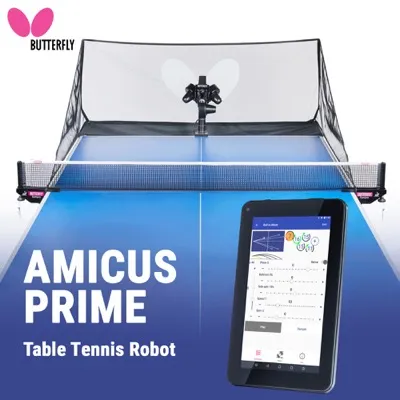
Among high-end robots at $1200-1600, the Power Pong 5000 competes with the Butterfly Amicus Prime at $2,000-2,500. Both robots target advanced players who need match-realistic drill simulation. Selection between them comes down to user interface preference and brand support availability.
Players who already own a robot in this price tier get diminishing returns from upgrading within the same segment. Larger gains come from jumping a full tier: budget to mid-range adds oscillation, mid-range to high-end adds programmable sequences.
Who Should Skip the Power Pong 5000?
Players who train solo less than 3 times per week get diminishing value from the Power Pong 5000’s high-end capabilities. At $1200-1600, the cost justifies daily or near-daily use, where the programmable sequences pay back through repeated practice. Mid-range robots cover lighter use cases at one-third the price.
Players who attend coached sessions or train regularly with partners receive better feedback than any robot provides. Robots fill the gap when partners are unavailable, not when they are.
Featured In
Related Robots
Is the Power Pong 5000 worth its price?
The Power Pong 5000 is justified for players who train solo 3-5 times per week and need programmable rally sequences with placement variation. Players who train with partners or attend coached sessions extract less value than dedicated solo trainers.
What spin types does the Power Pong 5000 produce?
The Power Pong 5000 delivers topspin, backspin, sidespin, no-spin. Spin output ranges from light to heavy on a numeric setting, allowing players to drill against varying spin levels within a single session.
Can the Power Pong 5000 simulate match play?
The Power Pong 5000 simulates rally patterns with up to 6-9 different ball types in sequence, including sidespin variations. For full match simulation including decision-making, no robot replaces a training partner.