Best overall: Butterfly Centrefold 25, with competition-grade 25mm surface and centrefold storage. Best home table: JOOLA Inside 18, best bounce under $600. Best budget: STIGA Advantage, playable quality at $350.
How Do You Evaluate a Table Tennis Table?
Table surface thickness is the single most important specification. A 25mm surface produces a consistent, even bounce across every point of the table. A 12mm surface produces dead spots, uneven bounce heights, and inconsistent ball behavior that makes practicing technique unreliable.
ITTF regulations require a 23cm bounce height when a standard ball is dropped from 30cm onto any point of the table surface. Only tables with 19mm+ surfaces meet this standard consistently. Beyond thickness, consider the undercarriage construction. A sturdy steel frame with adjustable leg levelers prevents wobble on uneven floors. Net quality matters too, though players replace the included net within the first year regardless of table price. Finally, evaluate storage dimensions against your available space: a centrefold table stores in roughly half the footprint of a two-piece design.
How Do the Best Table Tennis Tables Compare?
| Table | Surface | Bounce | Storage | Price | Best For |
|---|---|---|---|---|---|
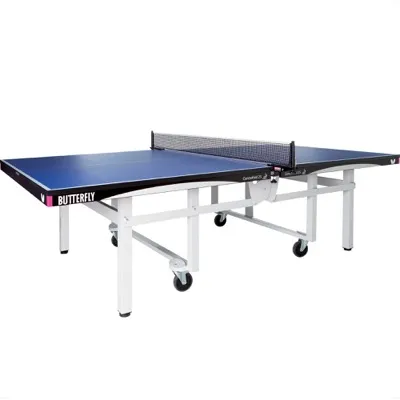 Butterfly Centrefold 25 Butterfly Centrefold 25 |
25mm | Compact fold | $1,800-2,200 | Competition, serious clubs | |
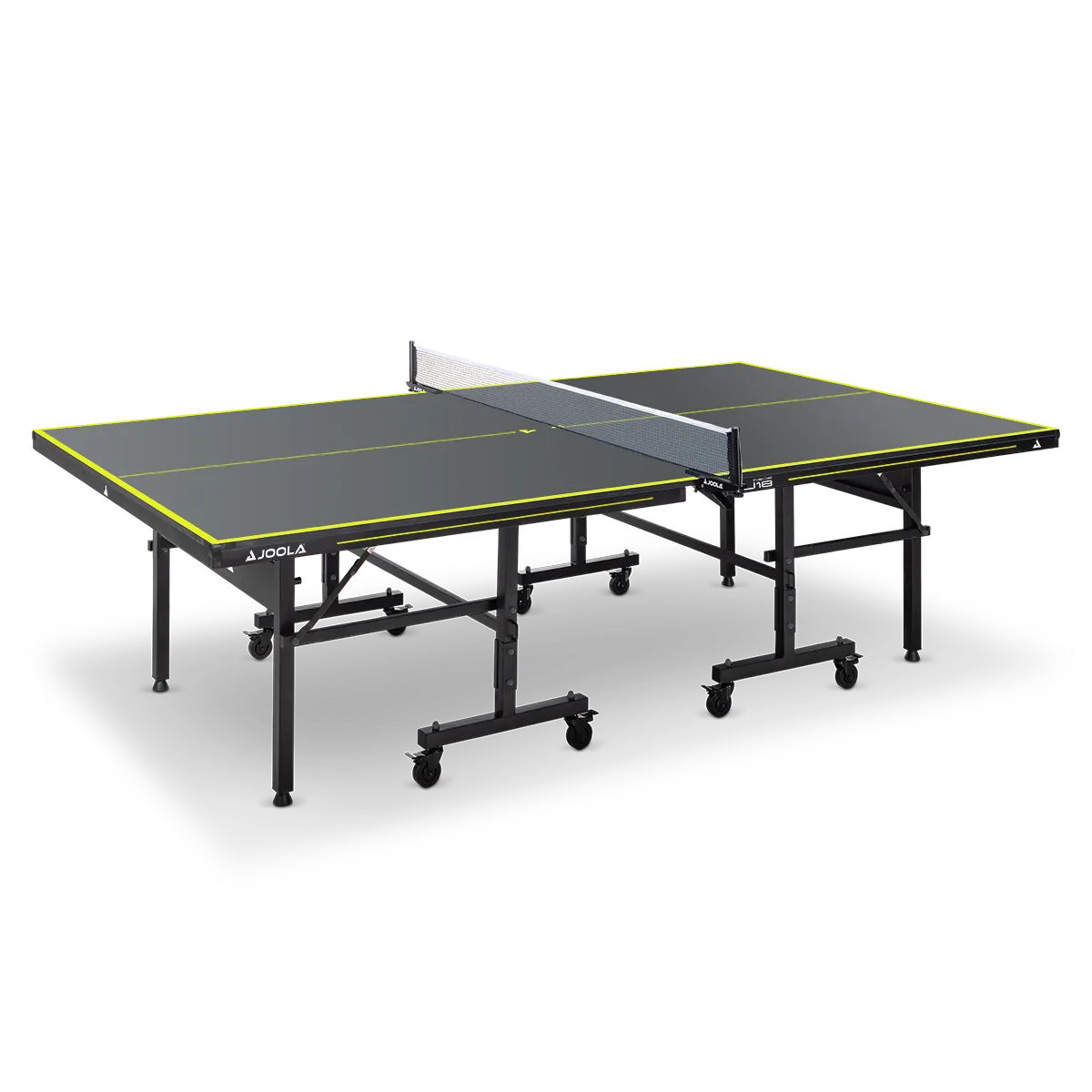 JOOLA Inside 18 JOOLA Inside 18 |
18mm | Two-piece fold | $450-550 | Home recreation | |
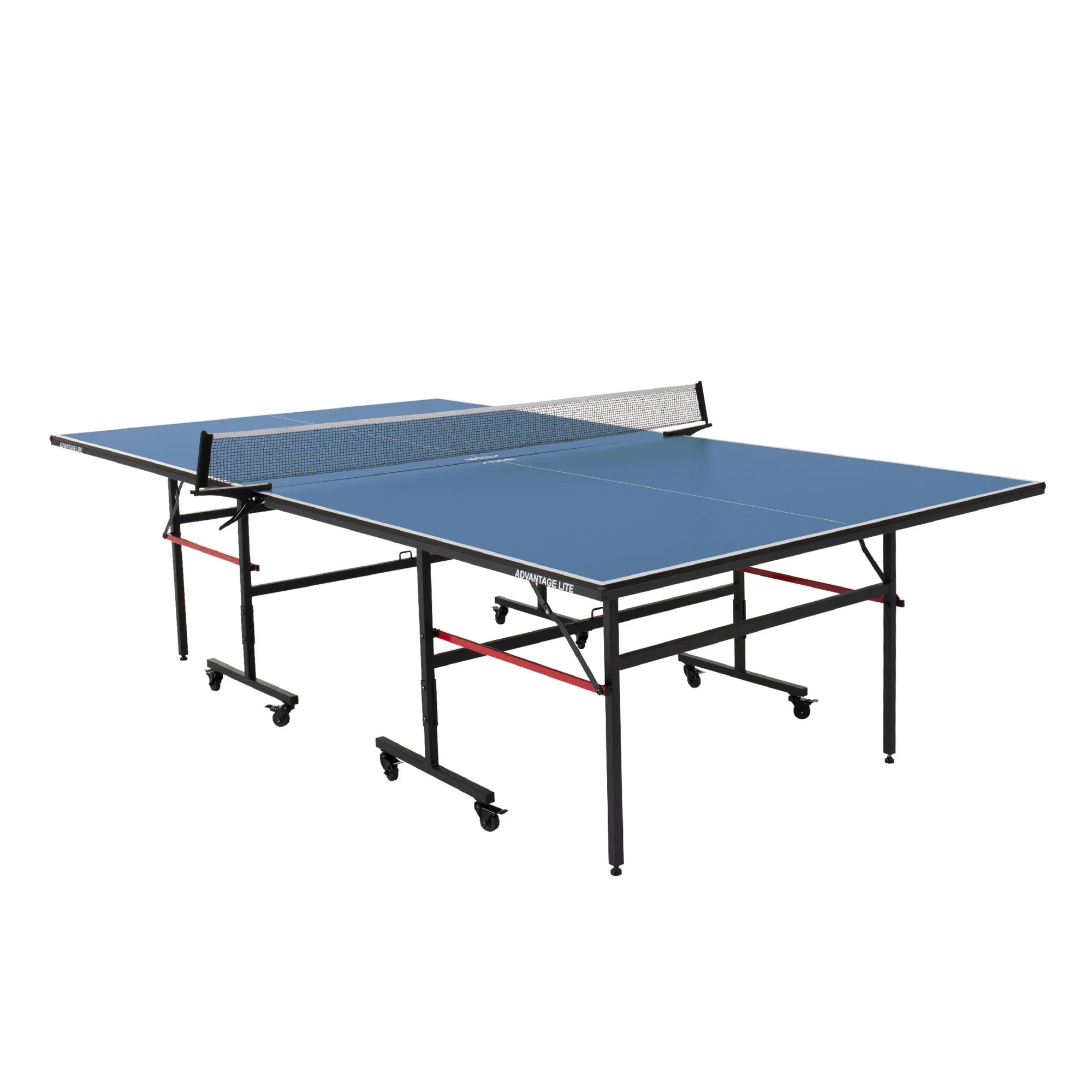 STIGA Advantage STIGA Advantage |
16mm | Compact fold | $350-400 | Budget home play | |
| Cornilleau 500M Outdoor | 7mm resin | Compact fold | $800-1,000 | Outdoor, weatherproof | |
| Killerspin MyT5 | 18mm | Two-piece fold | $500-650 | Home, compact spaces |
1. Butterfly Centrefold 25: Best for Competition and Clubs
Editor’s Pick Competition
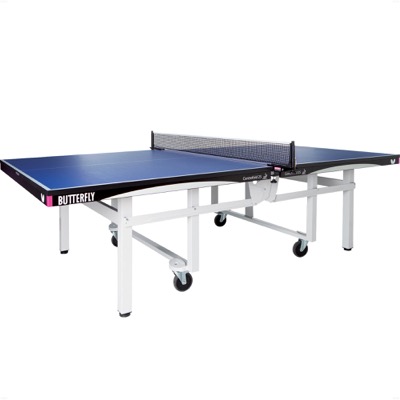
The Butterfly Centrefold 25 uses a 25mm MDF surface that delivers ITTF-approved bounce consistency across the entire playing area. The surface coating is Butterfly’s proprietary blue top-coat, which produces uniform friction and a predictable ball response on both topspin and backspin strokes. The steel undercarriage weighs over 100kg assembled, eliminating table movement during aggressive rallies. The centrefold mechanism allows the table to fold into a single compact unit, roughly 60cm x 155cm when stored upright, without needing to separate two halves.
At $1,800-2,200, this table is an investment for serious players and clubs. The 25mm surface is the same thickness used in World Championship and Olympic events. The bounce height uniformity across all nine zones of the playing surface varies by less than 1mm, which is critical for players developing advanced placement skills. If you pair this table with best paddles rated for competition, you have a training environment that matches tournament conditions exactly.
- ITTF-approved 25mm surface with tournament-grade bounce
- Centrefold storage saves significant floor space
- Extremely stable undercarriage, no wobble
- Surface will last decades with indoor use
- Premium price ($1,800-2,200) limits casual buyers
- Very heavy, difficult to move once positioned
- Overkill for purely recreational play
2. JOOLA Inside 18: Best for Home Recreation
Best Value Recreational
The JOOLA Inside 18 offers 18mm MDF surface thickness at $450-550. The best bounce quality available under $600. The two-piece fold-up design features independent halves on caster wheels, allowing one person to set up and store the table without help. Each half folds upright and rolls into a corner or against a wall. The included JOOLA net and post set is functional for recreational play, though competitive players will want to upgrade to a screw-clamp net.
The 18mm surface produces a bounce height that falls just short of ITTF standards but remains consistent enough for developing proper technique. Surface uniformity is good across the center and mid-zones, though the corners show slightly lower bounce compared to a 25mm table. For most home players, this difference is negligible. For players on a tighter budget, see our tables under $500 guide. The JOOLA Inside 18 sits at the price-performance sweet spot where surface quality and build construction meet without overpaying.
- Best bounce quality under $600
- Two-piece design allows solo setup and storage
- Includes net and post set
- Reliable 18mm surface for technique development
- Two-piece storage takes more floor space than centrefold
- Included net is basic quality
- Corner bounce slightly less consistent than 25mm tables
3. STIGA Advantage: Best Budget Table
Budget Pick Recreational
The STIGA Advantage uses a 16mm surface, the minimum thickness we recommend for any player who wants to develop real technique. At $350-400, the STIGA Advantage is the least expensive table on this list that still produces a bounce consistent enough for practicing serves and basic topspin strokes. The compact fold design with a single-player playback mode means you can practice solo by folding one half upright. The 1.5-inch steel apron provides reasonable stability, though the lighter frame does allow slight movement during aggressive rallies.
Assembly takes roughly 20-30 minutes and requires two people for the final step of attaching the halves to the undercarriage. The 16mm surface produces noticeably lower and less uniform bounce compared to the 18mm JOOLA or 25mm Butterfly, particularly near the edges and net area. For casual family play and beginners learning fundamentals, this trade-off is acceptable. For players who plan to train seriously, the extra $100-150 for an 18mm table is worth the investment. See our full tables under $500 guide for more options at this price point.
- Lowest price for a playable table ($350-400)
- Compact fold with solo playback mode
- Adequate for casual play and beginners
- Quick assembly compared to larger tables
- 16mm surface produces inconsistent bounce at edges
- Lighter frame allows some table movement
- Not suitable for serious training
4. Cornilleau 500M Outdoor: Best Weatherproof Table
Best Outdoor All Levels
The Cornilleau 500M uses a 7mm resin laminate surface specifically engineered for outdoor use. Unlike MDF or particleboard, this material is completely impervious to rain, humidity, and UV exposure. The surface will not warp, swell, or delaminate when left outside year-round. Cornilleau’s anti-glare coating reduces sun reflection, making outdoor play in direct sunlight significantly more comfortable than on a standard surface. The galvanized steel undercarriage resists rust, and the compact fold mechanism includes a safety lock and dual-wheel casters for moving the table across patios or decks.
The 7mm resin surface produces a bounce that is good for an outdoor material, rated 7.0/10. Though the ball feel is noticeably different from an MDF indoor table. Topspin strokes generate less grip on the resin surface, and the overall bounce height sits lower than a comparable indoor table. At $800-1,000, the Cornilleau 500M costs more than many indoor tables, but the Cornilleau 500M is the only table on this list that survives full weather exposure without a cover. For households where the only available space is a patio, deck, or garden, the Cornilleau 500M is the clear choice.
- Fully weatherproof, rain, sun, and humidity resistant
- Anti-glare coating for outdoor play in sunlight
- Good bounce for a resin surface
- Rust-resistant galvanized steel frame
- Expensive for a non-competition surface ($800-1,000)
- Resin surface produces less spin response than MDF
- Heavier than most indoor tables of similar size
5. Killerspin MyT5: Best for Compact Spaces
Space Saver Recreational
The Killerspin MyT5 features an 18mm MDF surface that matches the JOOLA Inside 18 in bounce quality, but distinguishes itself with a cleaner aesthetic design and slightly more compact storage profile. The two-piece fold-up design uses locking casters and an automatic anti-tilting mechanism for safe storage. Killerspin’s pocket design tucks the net storage into the frame, and the overall build quality, including powder-coated steel legs and corner protectors. Feels a step above most tables in the $500-650 range.
The 18mm surface delivers a 7.5/10 bounce rating with good consistency across the main playing zones. The MyT5 appeals to players who want a table that looks presentable in a living space rather than tucked away in a basement. The black-on-black frame and clean line markings give it a more modern appearance. Performance-wise, it sits very close to the JOOLA Inside 18, so the choice between them comes down to aesthetics and storage preference. Pair it with a quality paddle from our best paddles guide for a solid home setup. For a full breakdown of what to look for across all gear categories, see the complete equipment guide.
- 18mm surface matches more expensive tables in bounce
- Modern design complements living spaces
- Anti-tilting safety mechanism for storage
- Good build quality for the price
- Slightly more expensive than JOOLA Inside 18 for similar specs
- Two-piece design requires more storage space than centrefold
- Net included is basic quality
What Is the Difference Between Indoor and Outdoor Table Tennis Tables?
Indoor tables use wood-based surfaces (MDF or particleboard) that produce superior bounce consistency but cannot withstand moisture. Even brief exposure to rain or high humidity can cause an MDF surface to swell and warp permanently. Outdoor tables use weather-resistant materials (aluminum composite, melamine-coated board, or resin laminate) that sacrifice some bounce consistency for year-round durability.
If you have covered outdoor space (a garage, covered patio, or enclosed porch), an indoor table will always provide better playing quality than an outdoor table at the same price. The Cornilleau 500M is the exception that narrows this gap, but even the Cornilleau 500M’s 7mm resin surface cannot match the bounce feel of an 18mm MDF table. Choose outdoor only when the table will be genuinely exposed to weather.
How Much Space Does a Table Tennis Table Require?
A regulation table tennis table measures 274cm x 152cm (9ft x 5ft), and you need at least 3 meters of clearance behind each end for comfortable play. That means a dedicated playing space of roughly 6m x 4m. Most home players do not have a room that large, so storage design matters. Centrefold tables like the Butterfly Centrefold 25 fold into a single upright unit roughly 155cm x 60cm. Small enough to push against a wall. Two-piece tables like the JOOLA Inside 18 and Killerspin MyT5 create two separate halves that each stand upright but require twice the wall space. Before buying, measure your storage area and playing area. A table you cannot store conveniently becomes a table that stays set up permanently or never gets used.
Which Table Tennis Tables Should You Avoid?
Avoid any table with a surface thickness under 12mm. These ultra-thin tables, sold at big-box retailers for under $200, produce wildly inconsistent bounce that makes even casual play frustrating. The legs and frames on sub-$200 tables are typically lightweight aluminum that wobbles and shifts during rallies. No amount of padding or leveling fixes a 9mm surface. If your budget is tight, the STIGA Advantage at $350 is the floor for a table worth owning.
Table surface interacts with rubber properties. See our best rubbers guide for pairing recommendations. Read the complete equipment guide for all equipment categories.