iPong V300 Table Tennis Robot Review
The iPong V300 feeds 12-70 balls/min with topspin, backspin output at $100-150, a budget robot for solo training.
Specifications
| Ball Frequency | 12–70 balls/min |
| Oscillation | true |
| Programmable | false |
| Spin Types | topspin, backspin |
What Does the iPong V300 Do for Solo Training?
The iPong V300 feeds 12-70 balls/min with topspin, backspin output, sitting in the budget segment at $100-150. At the high end of the frequency range, the robot sends balls every 0.6-0.8 seconds, faster than most coached multiball drills.
The iPong V300 oscillates balls across the table width, forcing the player to move between shots. Footwork drills with oscillation at 60-80 balls per minute build the side-to-side movement that match play demands. Players who only practice fixed-position drills miss the movement component entirely.
The robot fits on one end of the table, with a hopper holding 120 balls between refills. At full hopper capacity and 60 balls per minute, the robot runs for 2 minutes between refills.
How Does the iPong V300 Compare to Other Robots in This Tier?
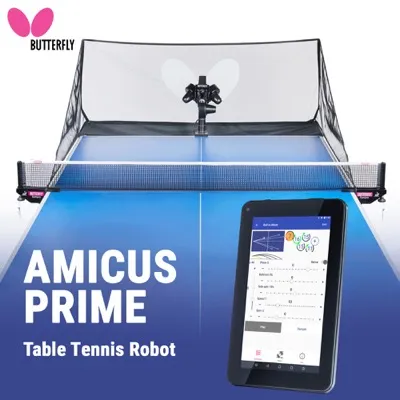
At $100-150, the iPong V300 competes in the entry-level robot segment. The Butterfly Amicus Prime at $2,000-2,500 sits at the opposite end of the market with tablet programming and rally sequences. The price gap reflects the capability gap: budget robots feed balls, high-end robots simulate rallies.
Players who already own a robot in this price tier get diminishing returns from upgrading within the same segment. Larger gains come from jumping a full tier: budget to mid-range adds oscillation, mid-range to high-end adds programmable sequences.
Who Should Skip the iPong V300?
Players rated above 1500 USATT outgrow the iPong V300’s capabilities within months. At the budget tier, fixed-position feeds without programmable sequences cannot simulate the rally patterns competitive practice requires. Upgrading to a mid-range robot with oscillation and rally programming returns measurable training gains.
Players who attend coached sessions or train regularly with partners receive better feedback than any robot provides. Robots fill the gap when partners are unavailable, not when they are.
Featured In
Related Robots
Is the iPong V300 worth its price?
The iPong V300 is justified for players who train solo 1-2 times per week and need placement variation across the table. Players who train with partners or attend coached sessions extract less value than dedicated solo trainers.
What spin types does the iPong V300 produce?
The iPong V300 delivers topspin, backspin. Spin output ranges from light to heavy on a numeric setting, allowing players to drill against varying spin levels within a single session.
Can the iPong V300 simulate match play?
The iPong V300 oscillates balls across the table at fixed spin types, useful for footwork drills. For full match simulation including decision-making, no robot replaces a training partner.