Butterfly Viscaria Blade Review
The Viscaria is Butterfly's flagship 7-ply Arylate-Carbon blade at 87g, delivering 9.0/10 speed with a direct trajectory for advanced offensive play.
· Updated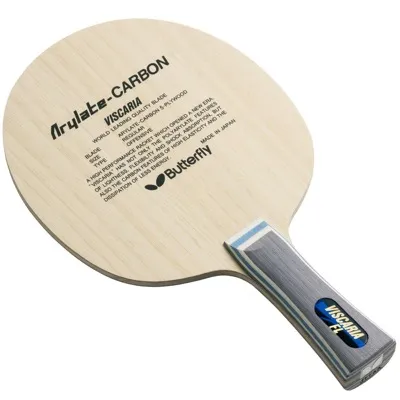
Specifications
| Composition | 5W + 2 Arylate-Carbon |
| Plies | 7 |
| Weight | 85g |
| handleType | FL |
| bladeThickness | 5.7mm |
| speedClass | OFF |
| reaction | 11.8 |
| vibration | 10.3 |
| Top Thickness | 5.8mm |
| headSize | 157x150mm |
What Makes the Viscaria the Standard for Advanced Blades?
The Butterfly Viscaria has been in continuous production since the early 1990s, making it one of the longest-running blade models in table tennis. Fan Zhendong, ranked world number one, uses the Viscaria in competition. The blade’s 7-ply construction with 2 Arylate-Carbon layers reaches 9.0/10 speed at 87g while maintaining 7.0/10 control, enough for advanced players to execute both powerful loops and delicate touch shots.
The Viscaria’s defining characteristic is its linear ball trajectory. When a player loops with the Viscaria, the ball travels in a flatter, more direct arc compared to all-wood blades or softer composites like the Timo Boll ALC. On hard contact, the blade emits a sharp, metallic ping from the carbon layers, distinctly different from the woody thud of an all-wood blade. This directness increases the ball’s pace on landing, making it harder for opponents to react. Advanced players who can control this trajectory gain a measurable attacking advantage.
At $150-190, the Viscaria is not the most expensive Butterfly blade (the Zhang Jike ALC costs $180-250), but it combines speed, consistency, and proven tournament performance in a way no competing blade matches at any price.
Which Rubbers Pair Best with the Viscaria?
Tenergy 05 on both sides is the most common Viscaria pairing for a fully offensive setup. The combination maximizes spin and speed but requires advanced technique to control. Players who use DHS Hurricane 3 on the forehand gain additional spin on short-distance loops, with Tenergy 05 on the backhand handling speed for counter-drives.
The Viscaria’s stiffness amplifies rubber characteristics: fast rubbers play faster on the Viscaria than on softer blades, and spin rubbers create more rotation. Because of this amplification, rubber selection matters more on the Viscaria than on flexible all-wood blades like the Nittaku Acoustic.
Featured In
Related Blades
Is the Viscaria too fast for intermediate players?
Most intermediate players (rated below 1600 USATT) find the Viscaria's 9.0/10 speed difficult to control consistently. The Timo Boll ALC offers similar construction with a softer, more forgiving feel at $10-20 less.
Why is the Viscaria so popular?
Fan Zhendong, the world number one, uses the Viscaria. Its Arylate-Carbon construction produces consistent speed with minimal vibration, and the blade has been in production since the 1990s, and players trust its proven performance.