Butterfly Timo Boll CAF Blade Review
The Timo Boll CAF is Butterfly's CA Fiber composite blade at 81g, rated 8.0/10 speed and 8.0/10 control at $105 for intermediate allround players.
· Updated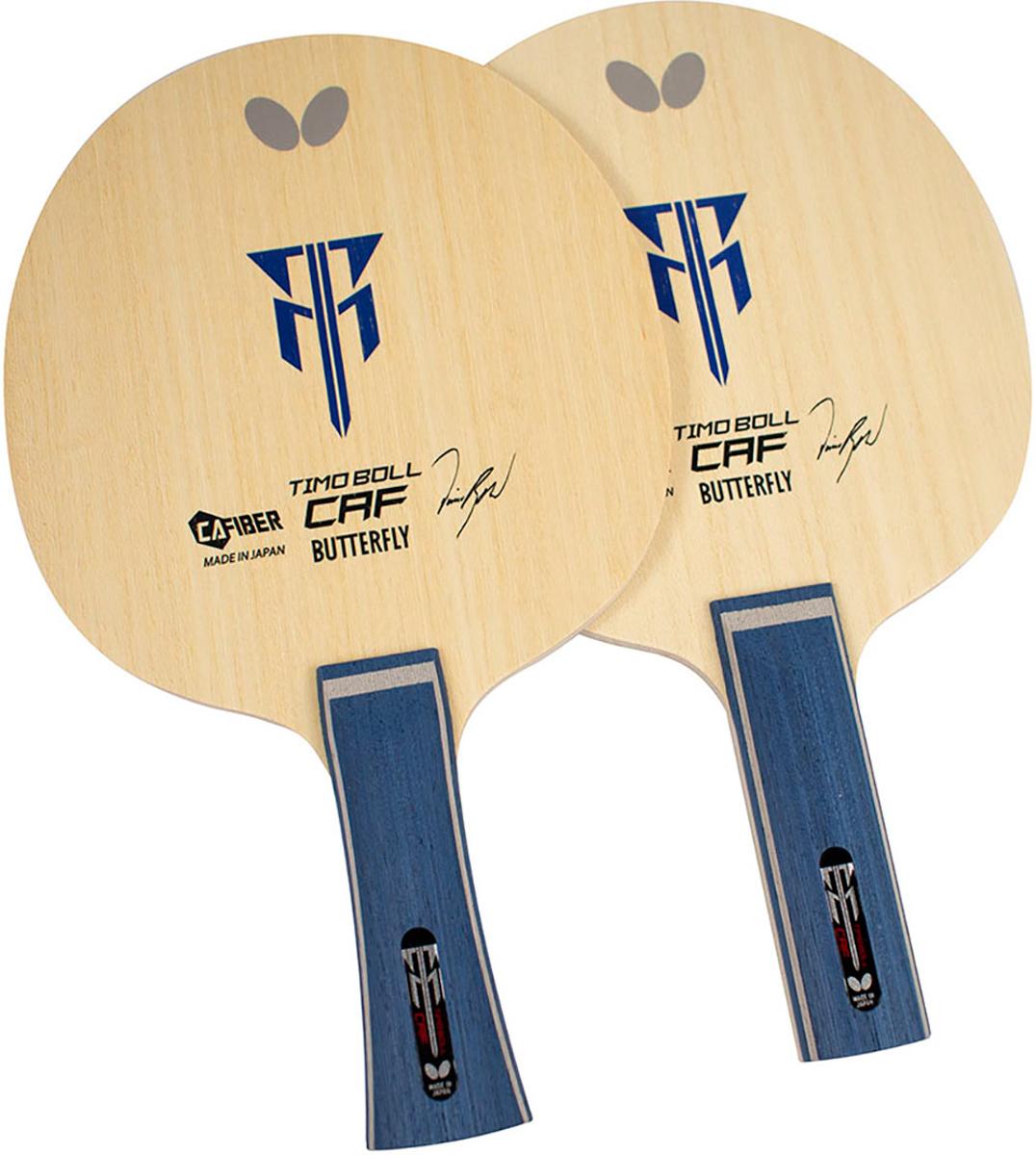
Specifications
| Composition | 3W + 2 CA Fiber |
| Plies | 5 |
| Weight | 81g |
| handleType | FL |
| bladeThickness | 5.7mm |
| speedClass | ALL+ |
| reaction | 10.6 |
| vibration | 10.4 |
| Top Thickness | 5.7mm |
| headSize | 157x150mm |
CA Fiber: Composite Speed with a Wooden Feel
The Timo Boll CAF bridges the gap between all-wood blades and full carbon composites. Its 3-wood, 2-CA-Fiber construction rates 8.0/10 speed and 8.0/10 control at 81g. CA Fiber, a cellulose-based material, adds stiffness without the hard, metallic feedback that Arylate-Carbon or ZLC fibers produce. On contact, the blade feels warm and flexible, closer to the Hadraw 5 than to the Viscaria.
That soft composite feel makes the Timo Boll CAF popular with players moving up from pure all-wood blades. The speed bump over a typical 5-ply wood blade measures about 0.5-1.0 points on Butterfly’s scale. Loops carry slightly more pace, drives penetrate deeper, and blocks redirect with a fraction more energy. None of these gains overwhelm an intermediate player’s control, which stays locked at 8.0/10.
At $105, the Timo Boll CAF sits below the Timo Boll ALC at $130+ and above the all-wood Timo Boll J at $70. The Donic Appelgren Allplay, a competing soft composite blade, sells for $60-80 but lacks Butterfly’s build consistency and the Timo Boll line’s proven design heritage.
Ideal Player Profile and Upgrade Path
Players rated 1200-1800 USATT who loop from mid-distance get the best results with the Timo Boll CAF. The blade generates enough speed for third-ball attacks without requiring the precise timing that faster carbon blades demand. Touch shots near the net retain sensitivity because CA Fiber dampens less feel than stiffer composites.
The Outerforce CAF uses the same CA Fiber material but places it in the outer plies rather than inner. This positioning creates a harder initial contact feel with slightly more direct power transfer. Players who find the Timo Boll CAF too soft for their attacking game should test the Outerforce CAF at $135 before jumping to a full carbon blade. Both share identical 8.0/10 speed and control ratings, so the difference is purely in feel and ball trajectory.
Related Blades
What is CA Fiber in the Timo Boll CAF?
CA Fiber is a cellulose-based composite that Butterfly places between the wood plies. It adds slight stiffness and speed over pure all-wood blades while preserving the soft, flexible feel that wood provides.
How does the Timo Boll CAF compare to the Timo Boll ALC?
The ALC uses Arylate-Carbon for 9.0/10 speed at $130+. The CAF uses softer CA Fiber for 8.0/10 speed at $105. The CAF feels closer to all-wood; the ALC plays distinctly like a carbon blade.