Butterfly Sardius Blade Review
The Sardius is Butterfly's stiffest T5000 Carbon blade, hitting 10/10 speed at 93g with 6.0/10 control, priced at $147 for power-focused attackers.
· Updated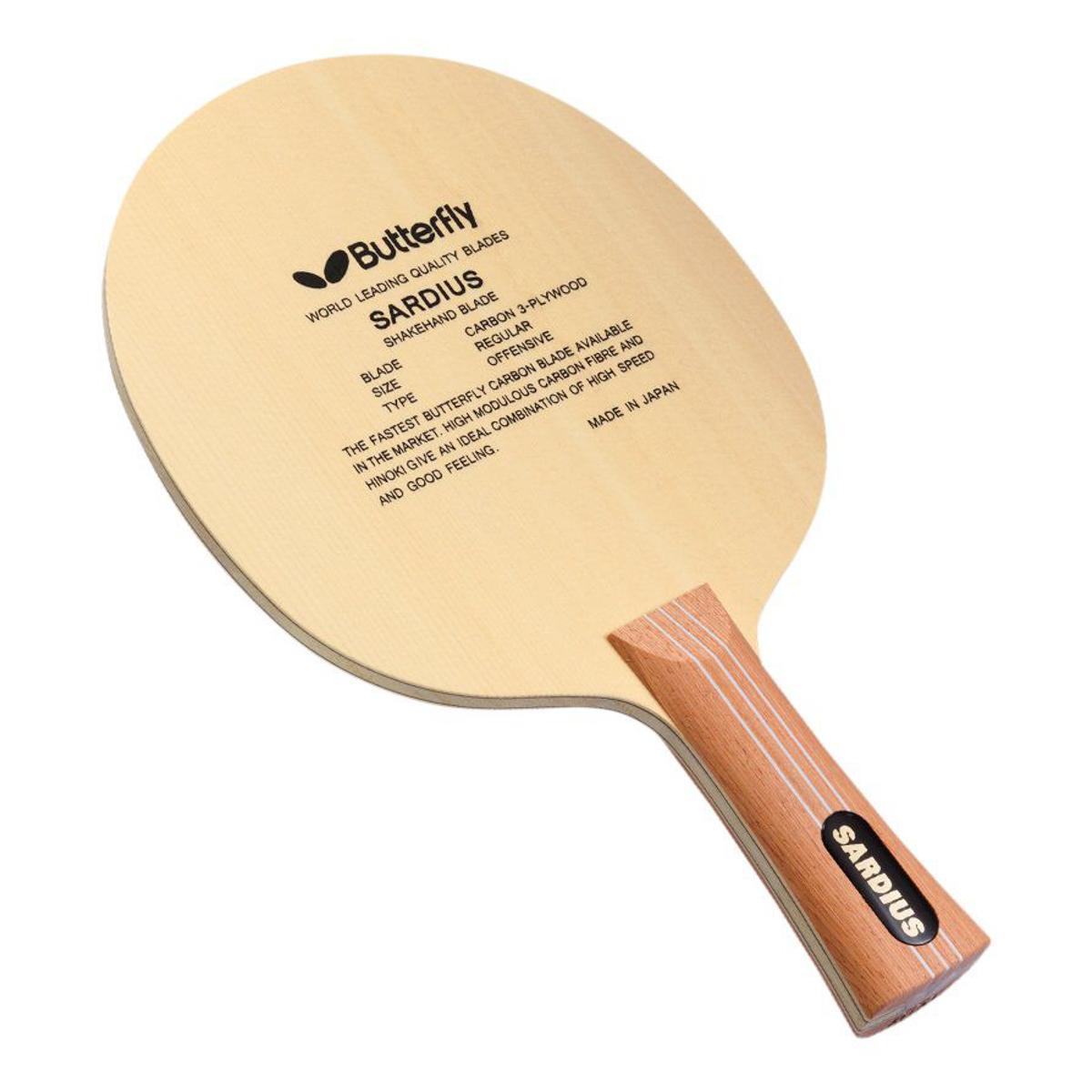
Specifications
| Composition | 3W + 2 T5000 Carbon |
| Plies | 5 |
| Weight | 93g |
| handleType | FL |
| bladeThickness | 5.7mm |
| speedClass | OFF+ |
| reaction | 12.8 |
| vibration | 14.4 |
| Top Thickness | 7.2mm |
| headSize | 158x152mm |
What Makes the Sardius Hit 10/10 Speed?
The Sardius reaches Butterfly’s maximum speed rating through a combination of stiff T5000 Carbon fiber and sheer mass. At 93g, it is the heaviest blade in this review by 2g over the Mizutani Jun Super ZLC (91g). The 3-wood, 2-T5000-Carbon construction in just 5 plies creates a rigid platform with almost no flex on contact. When the ball hits the Sardius, it rebounds immediately with minimal dwell.
That rigidity comes at a cost. Control drops to 6.0/10, the lowest rating among Butterfly’s current blade lineup. Touch shots near the net become a precision exercise, and receive returns require extreme softness in the wrist to avoid popping the ball long. Players who thrive with the Sardius hit hard on every stroke and rely on raw pace rather than spin variation to win points.
At $147, the Sardius costs less than half the price of the Mizutani Jun Super ZLC ($400), which also hits 10/10 speed. The Super ZLC achieves that speed with lighter, more advanced fiber technology at 91g and 6.5/10 control. Budget-conscious attackers who prioritize power over feel get more value from the Sardius.
How Does T5000 Carbon Compare to ZLC and ALC Fiber?
T5000 Carbon produces the hardest, most direct contact feel among Butterfly’s fiber technologies. There is no vibration dampening, no cushion, no forgiveness. The Primorac Carbon ($116) uses the same fiber type but dials back to 9.5/10 speed with a more manageable 6.5/10 control.
ALC blades like the Viscaria ($150-190) blend Arylate fiber with carbon to absorb vibration and create a softer, more spinnable contact. ZLC blades use lighter Zylon-carbon composites that balance speed with a cleaner feel. T5000 Carbon skips those refinements entirely. Players who have used all three fiber types often describe the Sardius as feeling like hitting with a solid board, and for pure hitters, that is exactly the point.
Related Blades
Is the Sardius the fastest Butterfly blade?
The Sardius ties with the Mizutani Jun Super ZLC at 10/10 speed, but it costs $147 versus $400. The Sardius achieves its speed through heavier mass (93g) and stiff T5000 Carbon rather than expensive Super ZL-Carbon fiber.
Can intermediate players use the Sardius?
At 6.0/10 control and 93g, the Sardius punishes mistimed strokes severely. Players below 1800 USATT will overshoot returns consistently. The Primorac Carbon ($116) at 9.5/10 speed offers a more practical starting point.