Butterfly Korbel SK7 Blade Review
The Korbel SK7 is a 7-ply all-wood blade at 92g, rated 8.5/10 speed and 7.0/10 control for $99, adding stiffness and pace over the standard 5-ply Korbel.
· Updated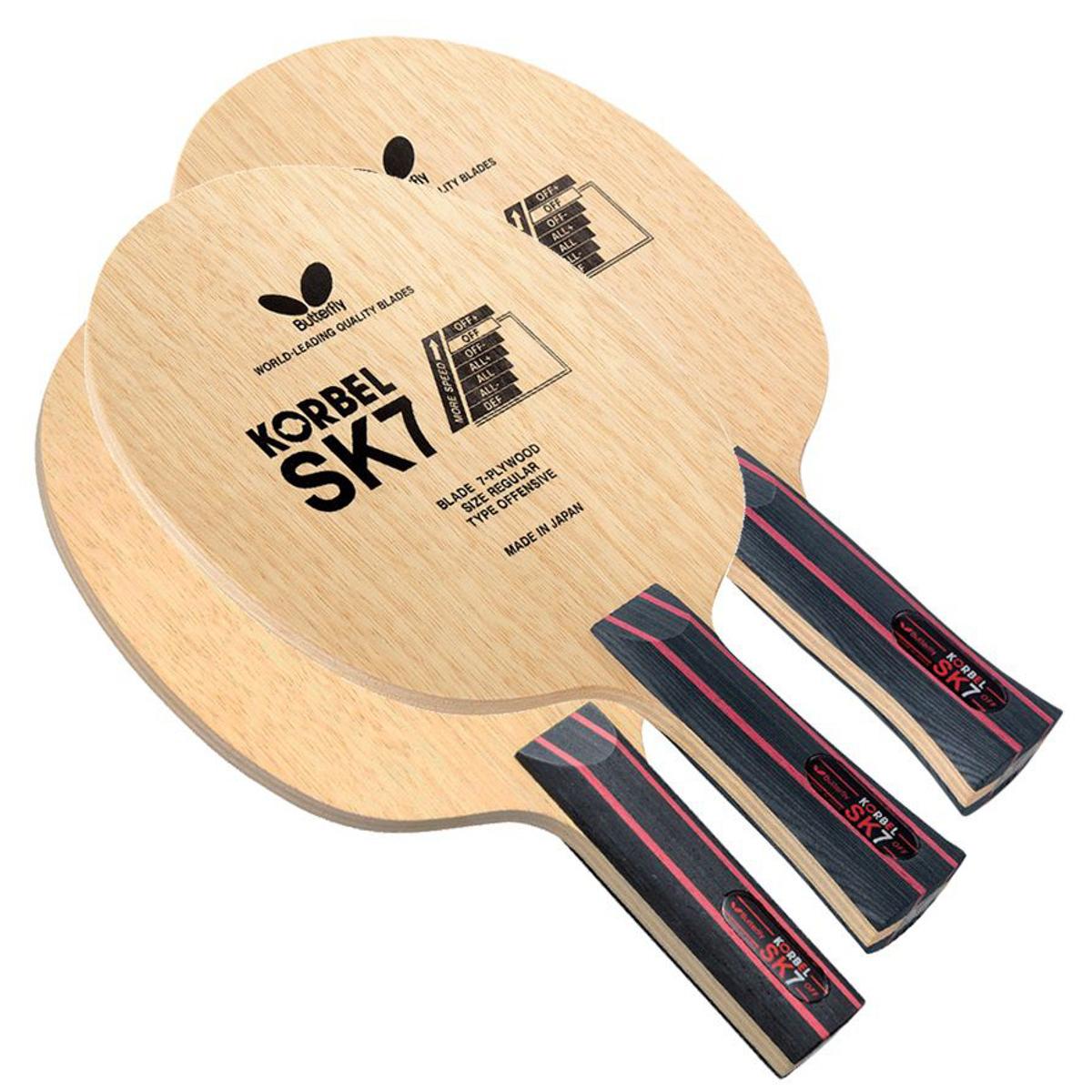
Specifications
| Composition | 7W all-wood |
| Plies | 7 |
| Weight | 92g |
| handleType | FL |
| bladeThickness | 6.2mm |
| speedClass | OFF |
| reaction | 11.1 |
| vibration | 9.3 |
| Top Thickness | 6.8mm |
| headSize | 157x150mm |
Seven Plies of Pure Wood Power
The Korbel SK7 rates 8.5/10 speed and 7.0/10 control from a 7-ply all-wood layup weighing 92g. Two extra plies over the standard Petr Korbel ($69) increase blade stiffness without introducing carbon or synthetic fibers. The result is a faster blade that retains pure wood vibration and feedback on every stroke. Players who reject carbon’s dampened feel but need more pace than a 5-ply blade can deliver land here.
At $99, the SK7 costs $30 more than the standard Korbel and $9 more than the SK7 Classic ($90). All three blades occupy the same weight class (92-93g) and share 7-ply or 5-ply all-wood construction, so the differences come down to ply arrangement and stiffness profiles. The SK7 Classic offers a larger sweet spot at marginally lower stiffness, while the Korbel SK7 concentrates its energy transfer in a tighter central zone.
Hard loops from mid-distance reveal the SK7’s strengths. The stiff construction rebounds quickly after contact, releasing the ball faster than flexible 5-ply blades. This quicker release adds 10-15% more ball speed on full-power forehand loops compared to the standard Korbel, based on coaching observations at competitive club levels.
Positioning Against Carbon Composites
The Korbel SK7 occupies the boundary between all-wood and composite performance. At 8.5/10 speed, it matches many entry-level carbon blades while preserving the tactile feedback that composite materials suppress. The Viscaria ($150-190) reaches 9.0/10 speed with Arylate-Carbon plies, but the Viscaria’s ball feel is distinctly stiffer and more metallic. Players described as “wood purists” prefer the SK7’s warmer, more resonant contact sensation.
For players rated 1400-1800 USATT, the SK7 handles competitive play without limitations. Third-ball attacks generate sufficient pace, and the 7.0/10 control still permits consistent serve returns and short game exchanges. Above 1800, most players migrate to composite blades for the additional half-point to full-point of speed needed at elite levels.
Practical Considerations
The 92g weight combined with 7-ply thickness (approximately 6.5mm) creates a substantial racket. Rubber selection should account for total weight: pairing with medium-weight rubbers like Butterfly Rozena (~42g per side) keeps the assembled racket near 176g. The Primorac at $77 offers a lighter (83g), more controllable alternative for players who find 92g fatiguing during multi-hour practice sessions.
Related Blades
Is the Korbel SK7 faster than the standard Korbel?
Yes. The SK7 rates 8.5/10 speed versus 8.0/10 for the standard Korbel. Two additional wood plies increase stiffness, producing a more direct energy transfer. Control drops from 7.5/10 to 7.0/10 as a result.
How does the Korbel SK7 compare to carbon blades?
The SK7 reaches 8.5/10 speed without composite materials. Carbon blades like the Viscaria hit 9.0/10 with less vibration. Players who dislike carbon's muted feel choose the SK7 for its natural wood feedback at comparable speed.