Butterfly Harimoto Innerforce ALC Blade Review
The Harimoto Innerforce ALC is a 7-ply inner-fiber blade at 87g with 8.5/10 speed and 8.0/10 control, priced around $185 for controlled offensive play.
· Updated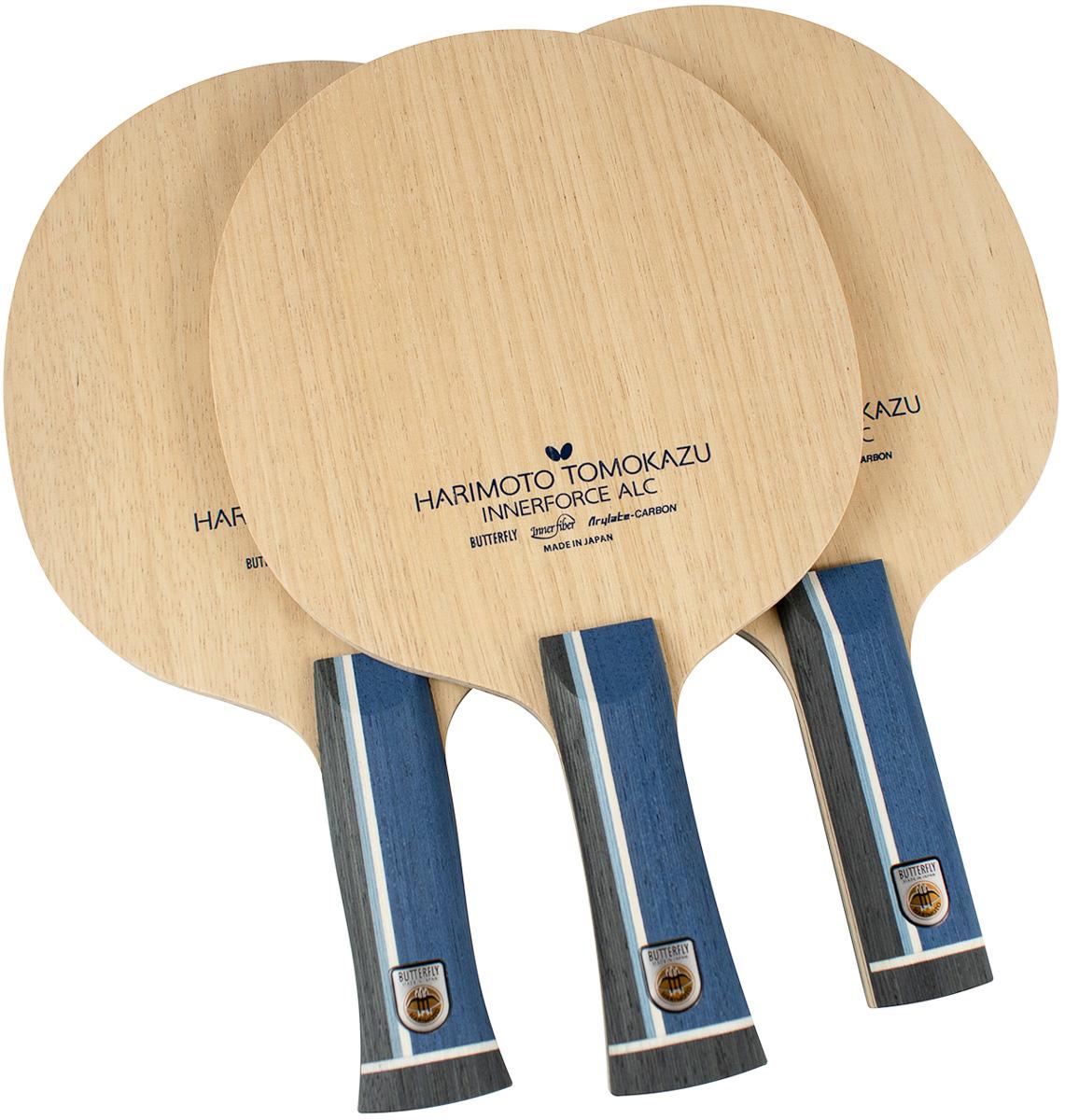
Butterfly
Butterfly Harimoto Innerforce ALC
Typical price: $185
Specifications
| Composition | 5W + 2 inner Arylate-Carbon |
| Plies | 7 |
| Weight | 87g |
| handleType | FL |
| bladeThickness | 5.7mm |
| speedClass | OFF |
| reaction | 10.7 |
| vibration | 9.2 |
| Top Thickness | 6mm |
| headSize | 158x152mm |
How Does Inner Fiber Placement Change the Playing Experience?
Inner-placed Arylate-Carbon layers sit directly beside the blade’s central wood ply rather than near the outer surface, and that position fundamentally alters ball contact. The Harimoto Innerforce ALC produces a higher, more arched ball trajectory than outer-fiber blades like the Timo Boll ALC. At 8.5/10 speed and 8.0/10 control, the blade gives advanced players enough power for third-ball attacks while keeping the ball on the table during extended rallies.
Tomokazu Harimoto, who reached the world’s top 3 as a teenager, uses this inner-fiber construction for its spin characteristics. The softer outer wood layers flex on contact before the carbon core engages, creating a two-phase energy transfer. Topspin loops carry more rotation because the ball spends longer on the rubber surface during the brushing phase. Flat hits still travel fast, but the blade forgives slight mis-hits that would sail long on stiffer outer-fiber constructions.
At $185, the Harimoto Innerforce ALC costs $35 more than the Viscaria at its lowest street price, while delivering notably different feel. Players choosing between the two are choosing between playing philosophies: the Viscaria’s direct, flat trajectory versus the Harimoto’s arched, spin-heavy flight path.
Which Players Get the Most from This Blade?
Players rated 1400-2000 USATT who loop as their primary attack find the Harimoto Innerforce ALC well matched to their game. The 8.0/10 control rating means short pushes and touch shots remain precise, unlike faster blades that require perfect soft hands for every passive stroke.
The Innerforce Layer ALC at $165 shares the same specs and construction without Harimoto’s name or handle customization. Players indifferent to handle shape save $20 by choosing the non-signature model. Those who want more speed from the same inner-fiber platform step up to the Harimoto Innerforce ZLC at $270, which uses ZL-Carbon for a stiffer response while keeping inner placement.
Related Blades
What does inner fiber placement mean for performance?
Inner-placed Arylate-Carbon sits closer to the blade's core, producing a softer feel and higher ball arc than outer placement. The Harimoto Innerforce ALC rates 8.0/10 control versus 7.5/10 for outer-fiber blades like the Timo Boll ALC.
Is the Harimoto Innerforce ALC better than the Innerforce Layer ALC?
Both share identical specs: 8.5/10 speed, 8.0/10 control, inner ALC fiber. The Harimoto version costs $185 versus $165, with Harimoto's preferred handle shape as the primary difference.