Butterfly Fan Zhendong Super ZLC Blade Review
The Fan Zhendong Super ZLC is Butterfly's fastest signature blade at 90g with 10/10 speed and 6.5/10 control at $400 for professional attackers.
· Updated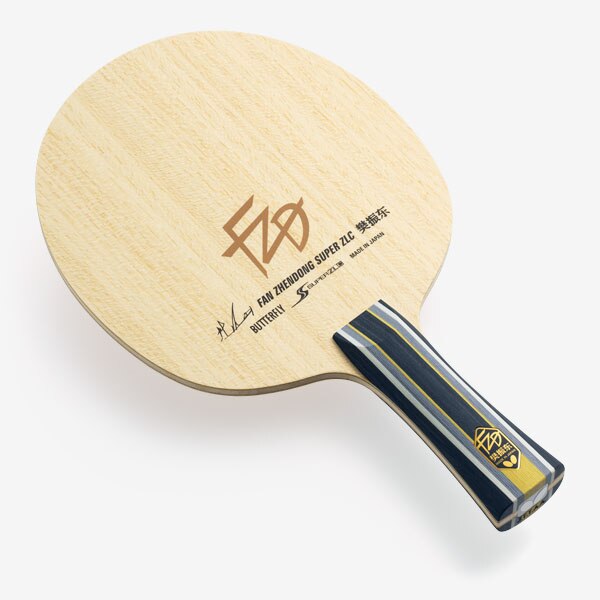
Specifications
| Composition | 5W + 2 Super ZL-Carbon |
| Plies | 7 |
| Weight | 90g |
| handleType | FL |
| bladeThickness | 5.7mm |
| speedClass | OFF+ |
| reaction | 12.3 |
| vibration | 11.1 |
| Top Thickness | 5.6mm |
| headSize | 157x150mm |
What Level of Player Needs 10.0/10 Speed?
The Fan Zhendong Super ZLC maxes out Butterfly’s speed scale at 10.0/10, producing the most explosive ball response in their blade catalog. At 90g and $400, this blade exists for players who compete at national and international levels. The Super ZL-Carbon fiber creates an extremely stiff hitting surface that launches the ball on a low, fast trajectory with minimal effort. Every stroke carries automatic pace.
That speed comes at a cost. Control drops to 6.5/10, the lowest of any blade in the Fan Zhendong line. Short pushes require deliberate soft hands because the blade amplifies even light contact. Players who grew up on all-wood blades will find the feedback sparse and dry. The ball leaves the surface before the hand registers full contact, and that demands anticipatory technique rather than reactive adjustment. Professional players train specifically to manage this kind of speed, and the Super ZLC rewards that training with devastating first-attack power.
Compared to the Fan Zhendong Super ALC at $250, the Super ZLC adds half a point of speed while dropping half a point of control. That gap looks small on paper but feels significant at the table. The Harimoto Innerforce Super ZLC at $400 offers a similar fiber at 9.5/10 speed with inner placement, giving more dwell time for spin generation.
Rubber Pairing Considerations
At 10.0/10 speed, rubber selection determines whether this blade is usable or uncontrollable. Tenergy 05 Hard (as opposed to standard Tenergy 05) provides the firmness needed to match the blade’s stiffness without creating a mushy contact feel. DHS Hurricane 3 Neo on the forehand anchors the setup with high spin and a defined contact point.
Softer rubbers collapse under the blade’s power transfer. The Viscaria at $150-190 is a better platform for medium-hard rubbers. Reserve the Super ZLC for setups built entirely around professional-grade sheets rated above 45 degrees hardness.
Related Blades
Can intermediate players use the Fan Zhendong Super ZLC?
No. At 10.0/10 speed and 6.5/10 control, intermediate players (below 1800 USATT) will overshoot consistently. The Viscaria at 9.0/10 speed and $150-190 is a far better fit.
What is the difference between Super ZLC and standard ZLC?
Super ZLC uses a tighter carbon weave that increases stiffness and power transfer. The Super ZLC rates 10.0/10 speed versus approximately 9.5/10 for standard ZLC blades, at a $100-150 price premium.