Butterfly Fan Zhendong Super ALC Blade Review
The Fan Zhendong Super ALC is a 7-ply blade with denser Arylate-Carbon weave at 89g, rated 9.5/10 speed and 7.0/10 control, priced around $250.
· Updated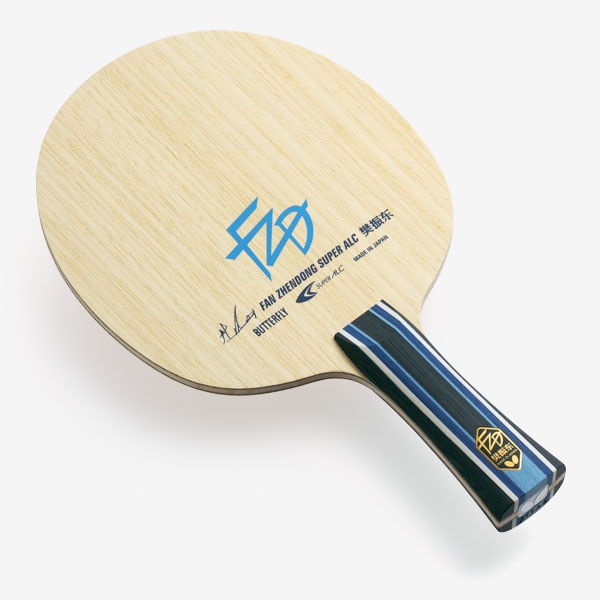
Specifications
| Composition | 5W + 2 Super Arylate-Carbon |
| Plies | 7 |
| Weight | 89g |
| handleType | FL |
| bladeThickness | 5.7mm |
| speedClass | OFF+ |
| reaction | 12.1 |
| vibration | 10.1 |
| Top Thickness | 5.7mm |
| headSize | 157x150mm |
How Does the Denser ALC Weave Change Performance?
Butterfly’s Super Arylate-Carbon weave packs more carbon fiber per square centimeter than standard ALC, and that density translates directly into power. At 9.5/10 speed, the Fan Zhendong Super ALC sits between the Viscaria (9.0/10) and the Fan Zhendong Super ZLC (10.0/10) in Butterfly’s lineup. The blade weighs 89g with 7.0/10 control, giving advanced players a noticeable step up in raw attacking force without jumping to the less forgiving ZLC fiber.
On forehand loops from mid-distance, the Super ALC generates a flatter trajectory than standard ALC blades. The ball arrives faster and kicks lower off the bounce, compressing the opponent’s reaction window. Close-to-table blocking feels stable at this speed level because the 5-wood core absorbs enough vibration to maintain ball placement. Players transitioning from the Timo Boll ALC at $150 will notice the difference immediately on third-ball attacks, where the extra speed turns a pressuring loop into a winning one.
Who Benefits Most from This Blade?
Tournament players rated 1800+ USATT gain the most from the Super ALC’s power profile. At $250, it costs $60-100 more than the Viscaria and demands precise footwork to use effectively. Players who loop from mid-distance on the forehand and counter-drive on the backhand will find the 9.5/10 speed rewarding. Those who rely on touch play and short game control are better served by the Fan Zhendong CNF at the same price, which trades speed (9.0/10) for superior ball feeling (8.0/10 control).
Rubber pairing matters more at this speed tier. Tenergy 05 on both sides is the standard offensive setup, but pairing DHS Hurricane 3 on the forehand with Tenergy 05 on the backhand gives the blade a spin-heavy forehand loop that complements its raw pace. Softer rubbers like Yasaka Mark V lose their character on a blade this fast and are not recommended.
Related Blades
How does the Super ALC differ from the standard Viscaria?
The Super ALC uses a denser Arylate-Carbon weave, producing 9.5/10 speed versus the Viscaria's 9.0/10. It weighs 89g (2g heavier) and costs $60-100 more at $250.
Is the Fan Zhendong Super ALC worth the price over the Timo Boll ALC?
At $250 versus $150, the Super ALC delivers 9.5/10 speed compared to 8.5/10. Players rated above 1800 USATT benefit from the extra power. Below that, the Timo Boll ALC offers better value.