Butterfly Fan Zhendong CNF Blade Review
The Fan Zhendong CNF is a 7-ply Cellulose Nanofiber blade at 89g with 9.0/10 speed and 8.0/10 control at $400 for spin-focused advanced play.
· Updated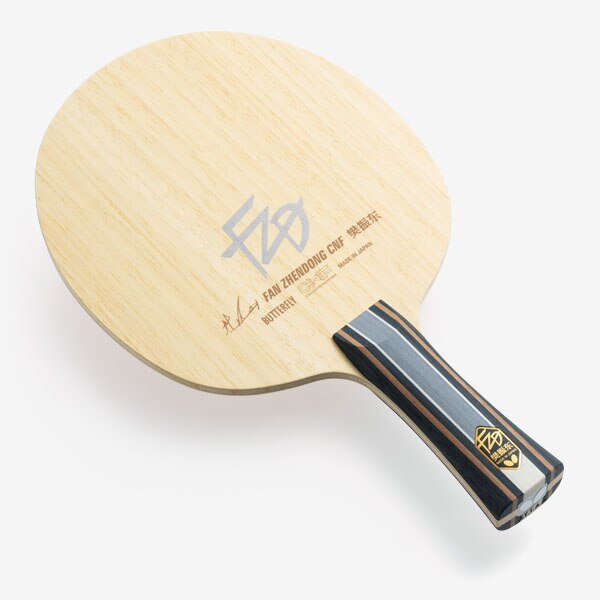
Specifications
| Composition | 5W + 2 Cellulose Nanofiber |
| Plies | 7 |
| Weight | 89g |
| handleType | FL |
| bladeThickness | 6.2mm |
| speedClass | OFF |
| reaction | 11.7 |
| vibration | 9.5 |
| Top Thickness | 5.7mm |
| headSize | 157x150mm |
What Does Cellulose Nanofiber Do That Carbon Cannot?
CNF fiber absorbs vibration at the point of contact, and that absorption gives the blade a distinctly wood-like feel at carbon-level speed. The Fan Zhendong CNF reaches 9.0/10 speed, matching the Viscaria exactly, but delivers 8.0/10 control versus the Viscaria’s 7.0/10. At 89g, the blade sits at the same weight class as the Fan Zhendong Super ALC, but the ball stays on the rubber surface measurably longer during topspin strokes.
That extended dwell time changes how spin behaves. Forehand loops carry heavier rotation because the ball wraps around the rubber before launching, rather than skipping off a stiff carbon surface. Players who generate spin through brushing contact rather than raw arm speed benefit most from this construction. The CNF layers sit in the same position as ALC in traditional 7-ply construction (outer placement flanking the core wood plies), so the blade’s overall structure is familiar to anyone upgrading from a standard ALC blade.
Is $400 Justified for a 9.0/10 Speed Blade?
At $400, the Fan Zhendong CNF costs more than double the Viscaria ($150-190) for the same speed rating. The price reflects Butterfly’s newer CNF material technology, not additional power. Players paying this premium buy ball feeling and control, not speed.
The Harimoto Innerforce ALC at $185 offers a different path to high control (8.0/10) with inner fiber placement at 8.5/10 speed. That blade costs less than half the CNF and delivers a similar balance of touch and offense, though the CNF’s outer fiber placement produces a crisper, more direct ball trajectory compared to the softer arc of inner-fiber designs.
For players who want CNF’s vibration dampening without the $400 price tag, no budget alternative exists in Butterfly’s lineup. The technology remains exclusive to premium models, making the CNF a specialized choice for players who prioritize feel above all other factors.
Related Blades
What is CNF fiber in table tennis blades?
CNF stands for Cellulose Nanofiber, a plant-derived composite that dampens vibration more than carbon. Butterfly rates CNF blades at 8.0/10 control versus 7.0/10 for equivalent ALC models.
How does the Fan Zhendong CNF compare to the Viscaria?
Both reach 9.0/10 speed, but the CNF delivers 8.0/10 control versus 7.0/10. The CNF costs $400 compared to $150-190. The extra $200+ buys a softer, more controlled hitting feel.