Butterfly Balsa Carbo X5 Blade Review
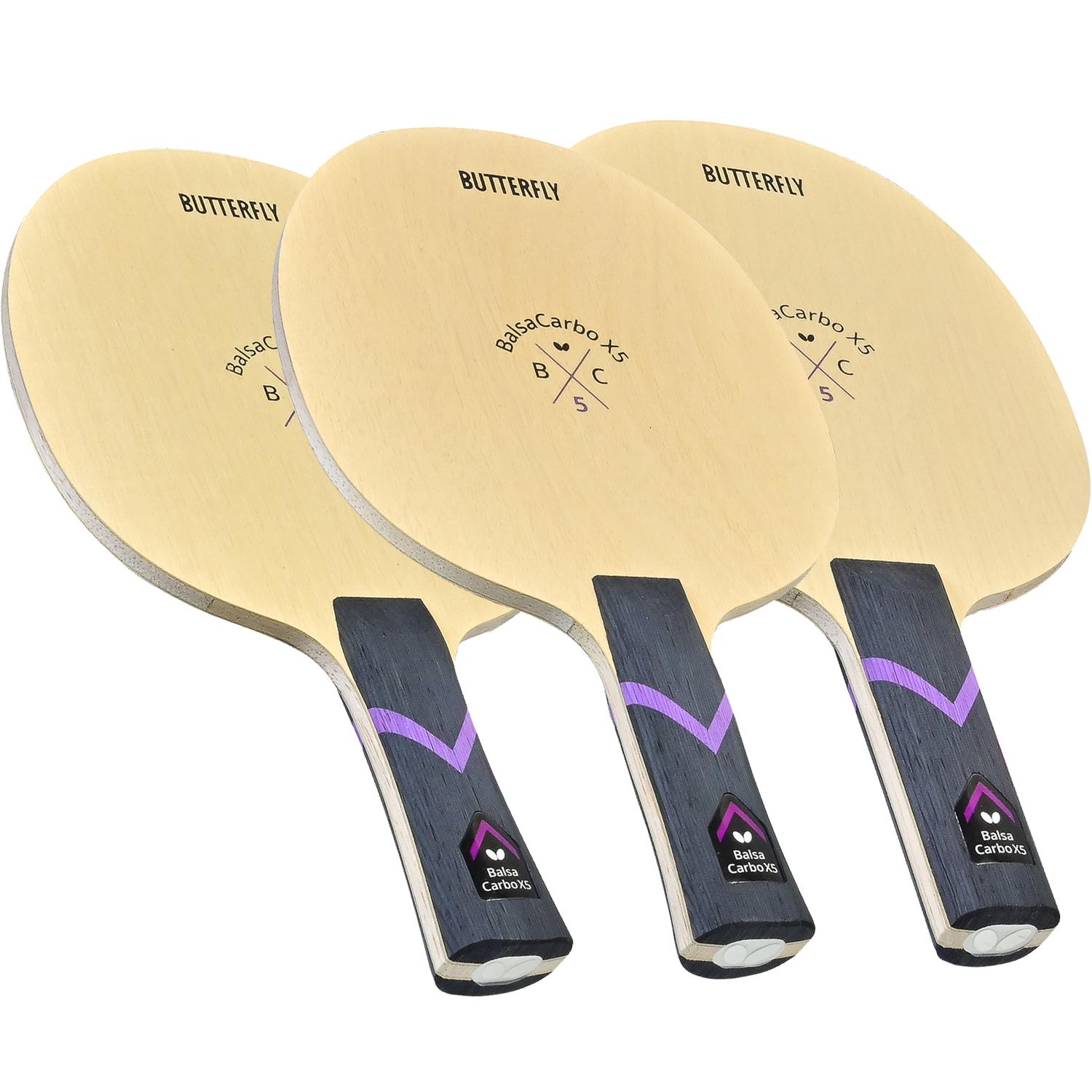
The Balsa Carbo X5 is Butterfly's ultralight carbon blade with a balsa core at 72g, rated 8.0/10 speed and 8.0/10 control at $77 for offensive players.
· UpdatedSpecifications
| Composition | 3W + 2 Carbon (balsa core) |
| Plies | 5 |
| Weight | 72g |
| handleType | FL |
| bladeThickness | 5.7mm |
| speedClass | ALL+ |
Offensive Speed at Ultralight Weight
The Balsa Carbo X5 delivers 8.0/10 speed at just 72g by combining a balsa wood core with carbon outer layers. Standard offensive blades weigh 82-90g. That 10-18g difference translates to measurably faster racket acceleration through the stroke, allowing players to generate speed through swing velocity rather than blade mass. Quick-wristed loopers and players who rely on fast transitions between forehand and backhand benefit most from the reduced weight.
Carbon layers on the outside of the blade provide the structural stiffness that balsa alone cannot deliver. Pure balsa would flex too much on hard contact, losing energy. The carbon shell keeps the blade rigid during high-impact loops while the balsa core absorbs vibration that denser woods would transmit to the hand. Control rates 8.0/10, matching heavier all-wood blades like the Hadraw 5 at 85g.
At $77, the Balsa Carbo X5 is one of the least expensive carbon blades in Butterfly’s range. The Falcima costs $74 as a pure all-wood option with 8.5/10 speed but 10g more weight. The JOOLA Viking, a competing balsa-carbon blade, sells for $80-100 with a similar construction philosophy.
Playing Characteristics and Tradeoffs
The balsa core produces a distinctive feel. Contact sounds different from dense-wood blades, with a lighter, slightly hollow tone. Some players find this less satisfying than the solid thud of an all-wood Hadraw VR at 89g. Others prefer it precisely because the feedback is distinct and easy to read during fast exchanges.
Blocking at 72g requires adjustment. Heavier blades absorb incoming pace through mass. The Balsa Carbo X5 depends on the player’s grip and wrist stability to resist deflection on hard blocks. Players who primarily loop and drive rather than block find this a non-issue. The blade’s strength is racket speed on the attack, not passive resistance on defense.
The Viscaria at 87g and 9.0/10 speed outpaces the Balsa Carbo X5 in raw power. Players willing to carry the extra 15g get a blade that hits harder on every stroke. The Balsa Carbo X5 appeals specifically to players who prioritize speed of movement over weight of contact.
Related Blades
Why is the Balsa Carbo X5 so light?
Balsa wood has a density of 100-200 kg/m3, roughly one-third of typical blade woods. Using balsa as the core ply drops total weight to 72g while the outer carbon layers maintain structural rigidity and speed.
Does the Balsa Carbo X5 feel hollow?
The balsa core creates a distinct, slightly hollow sound on contact compared to dense all-wood blades. Some players describe the feel as less solid than the Viscaria's 87g. The tradeoff is faster racket acceleration from the 72g weight.