Butterfly Apolonia ZLC Blade Review
The Apolonia ZLC is Butterfly's 7-ply outer ZL-Carbon blade at 91g, rated 8.5/10 speed and 7.5/10 control for $270.
· Updated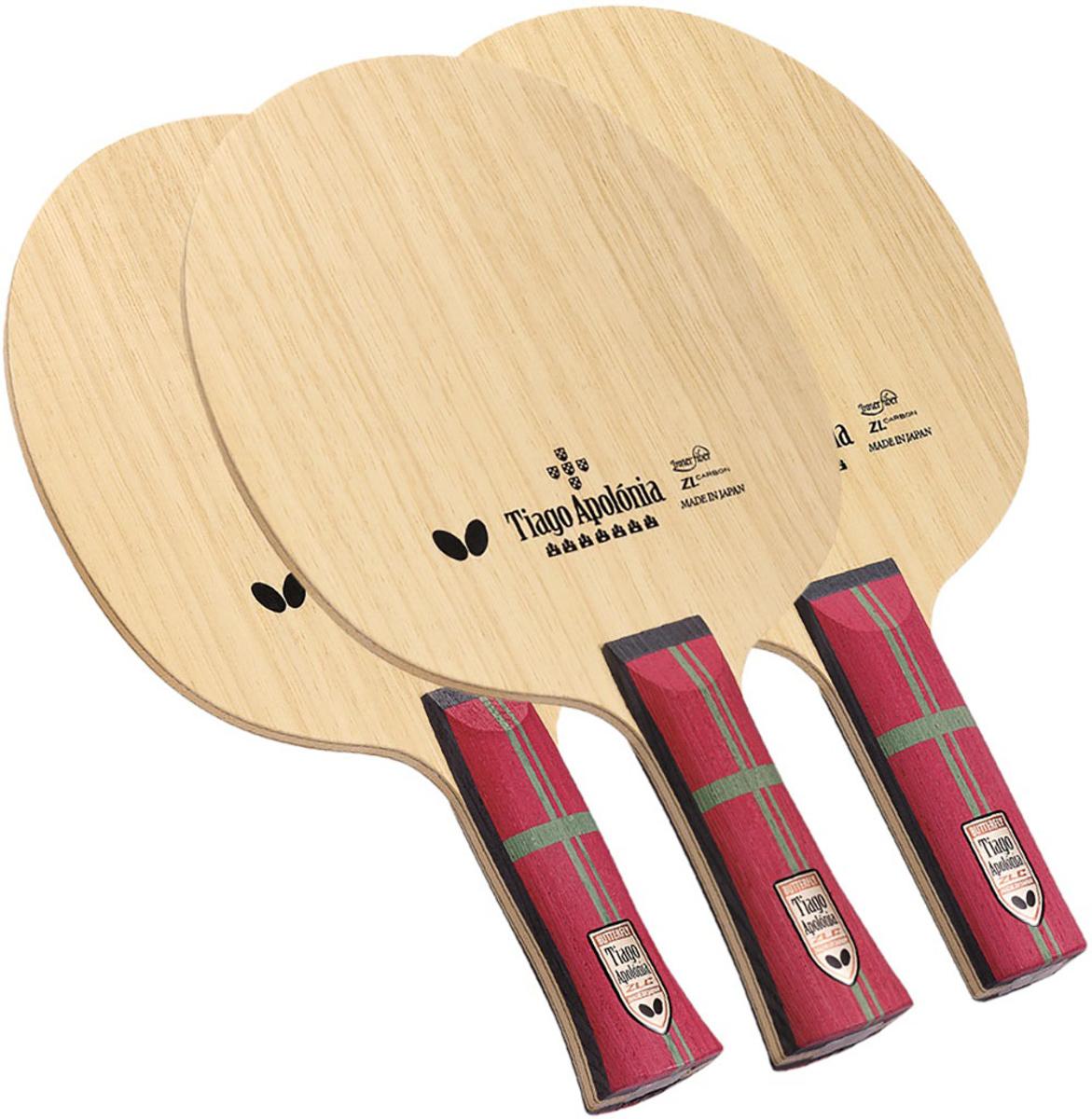
Specifications
| Composition | 5W + 2 ZL-Carbon |
| Plies | 7 |
| Weight | 91g |
| handleType | FL |
| bladeThickness | 5.7mm |
| speedClass | OFF |
| reaction | 10.5 |
| vibration | 9.5 |
| Top Thickness | 5.7mm |
| headSize | 157x150mm |
How Does 91g Change a ZLC Blade’s Character?
The Apolonia ZLC is the heaviest blade in Butterfly’s current ZLC lineup, and that mass serves a specific purpose. Tiago Apolonia built his game around powerful mid-distance forehand loops that require the blade head to carry momentum through the ball. At 91g, each loop transfers more energy on contact compared to lighter ZLC models like the Timo Boll ZLC at 85g. The result is heavier ball contact that opponents describe as difficult to block cleanly.
The outer ZL-Carbon placement adds direct energy transfer: fibers near the surface engage immediately on contact rather than flexing first. Combined with the 91g mass, this produces loops that travel with pace and weight, forcing opponents to adjust their block angle precisely or risk the ball deflecting off their rubber. The 8.5/10 speed rating appears modest next to the Timo Boll ZLC’s 9.5/10, but the Apolonia compensates with sheer impact force.
At $270, the Apolonia ZLC matches the Timo Boll ZLC and Franziska Innerforce ZLC in price. Players who generate power through body rotation and weight transfer, rather than arm speed alone, find the heavier blade amplifies their technique. The Viscaria at 87g and $150-190 offers a lighter, cheaper entry point for players unsure about committing to 91g.
Which Playing Style Benefits from Extra Mass?
Loopers who position 1.5-3 meters behind the table and drive through the ball with full-body rotation gain the most from the Apolonia’s weight. The extra grams generate a flywheel effect: once the racket reaches speed, it resists deceleration through the contact zone, maintaining ball speed even on off-center hits. Close-table players feel the weight differently, as the 91g slows racket recovery between quick backhand-forehand transitions.
Pairing the Apolonia ZLC with a medium-hard rubber like Tenergy 05 produces a powerful but demanding setup. The Freitas ALC at 88g and $185 offers a similar power-oriented approach with Arylate-Carbon instead of ZL-Carbon, at $85 less. Players choosing between these two blades should consider whether the ZL-Carbon’s additional elasticity justifies the price premium over proven Arylate-Carbon performance.
Related Blades
Why is the Apolonia ZLC heavier than other ZLC blades?
At 91g, the Apolonia ZLC is 6g heavier than the Timo Boll ZLC (85g). The extra mass comes from denser wood plies selected for power on mid-distance loops, Tiago Apolonia's primary attacking stroke.
Is the Apolonia ZLC as fast as the Timo Boll ZLC?
No. The Apolonia rates 8.5/10 speed versus 9.5/10 for the Timo Boll ZLC, despite both using ZL-Carbon. The Apolonia's outer fiber placement and heavier weight prioritize power transfer over raw ball speed.