Butterfly Amicus Prime Robot Review
The Butterfly Amicus Prime is a tablet-controlled table tennis robot with programmable spin, speed, placement, and rally sequences at $2,000-2,500.
· Updated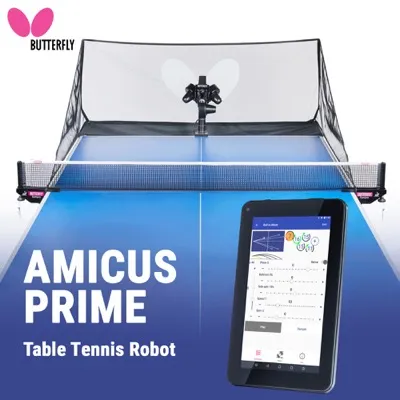
Butterfly
Butterfly Amicus Prime
Typical price: $2000–2500
Specifications
| ballFrequency | 10–120 balls/min |
| oscillation | true |
| programmable | true |
| spinTypes | topspin, backspin, sidespin, no-spin |
| controller | Bluetooth tablet |
| programmableShots | 10 |
| drillMemory | unlimited |
| shotTypes | 12 |
| ballCapacity | 120 |
| Weight | 20.2lbs |
| warranty | 3 years |
| madeIn | Hungary |
What Does the Amicus Prime Do That Cheaper Robots Cannot?
The Butterfly Amicus Prime connects to a tablet app that lets players program multi-ball sequences with control over spin type (topspin, backspin, sidespin, no-spin), spin intensity (10 levels), ball speed (10 levels), and placement (any point on the table). Sequences chain up to 9 different ball types into rally patterns, the critical capability cheaper robots lack. A player can program: short backspin serve to forehand, long topspin to backhand, then fast drive to crossover, practicing a specific tactical sequence repeatedly.
At $2,000-2,500, the Amicus Prime costs 4-5x more than the Newgy Robo-Pong 2055 ($245-500). The Newgy sends balls with spin and speed variation to random or fixed positions but cannot chain specific sequences. The iPong V300 ($100-150) is the entry-level option that oscillates balls without spin, good only for basic rally practice.
The Amicus Prime feeds 120 balls per hopper load. Its ball recycling net catches balls and returns them to the hopper, enabling continuous practice without stopping to collect balls. The robot fits on one table end and weighs 8.5 kg, light enough to move between tables. The feeding mechanism clicks audibly before each ball launch, giving players a rhythmic timing cue that mimics the cadence of a human training partner’s feeds.
Who Gets the Most Value from the Amicus Prime?
Players rated 1200-2000 USATT who practice solo 3-5 times per week extract the most training value from the Amicus Prime. At this level, players have developed basic strokes and need repetition of specific tactical patterns, exactly what the sequence programming handles. Players below 1200 benefit more from coaching or multiball practice with a training partner, where a human can adjust feeds based on the player’s stroke quality.
Clubs and training facilities recover the Amicus Prime’s cost through member usage and coaching sessions. A single robot serves multiple players per day, making the per-session cost lower than paying a practice partner or coach for multiball feeding.
Featured In
Is the Amicus Prime worth $2,000+?
The Amicus Prime is justified for players who practice solo 3+ times per week and need match-realistic drills. Players who practice once weekly or less get adequate value from the Newgy Robo-Pong 2055 at $245-500.
Can the Amicus Prime simulate match play?
The Amicus Prime can program rally sequences of up to 9 balls with different spin, speed, and placement combinations. While it cannot replicate an opponent's decision-making, it can simulate specific rally patterns like serve-receive-loop or push-push-attack.