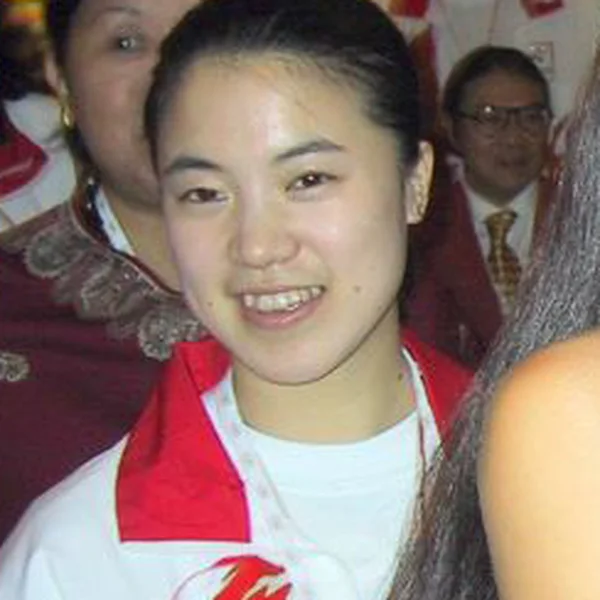
Wang Nan is a retired Chinese table tennis (also known as ping pong) player who won 4 Olympic gold medals, 15 World Championship titles, and 5 World Cup singles titles across a 13-year senior international career from 1995 to 2008. Wang Nan played a left-handed shakehand offensive looping style built on relentless ball placement, exceptional consistency, and the all-court coverage left-handers gain against right-handed opponents. Her equipment configuration followed the Chinese national-team standard of the late 1990s and 2000s: a Chinese composite blade paired with DHS Hurricane tacky rubber on the forehand. The sections below document her equipment era, explain how the left-handed shakehand setup shaped her tactical advantages, break down the career stats that established her as the most decorated women’s player at her retirement, and trace her doubles partnerships and post-2008 administrative role.
What Equipment Did Wang Nan Use?
Wang Nan used Chinese national-team standard equipment through her 1995-2008 career: a Chinese-manufactured all-wood or thin-composite blade with DHS Hurricane tacky rubber on the forehand. Exact model designations from her competitive era predate current commercial product lines, but the architectural pattern is reproducible.
The table below maps Wang Nan’s equipment era to its modern commercial equivalents:
| Component | Wang Nan’s Era (1995-2008) | Modern Commercial Equivalent |
|---|---|---|
| Blade | Chinese national-team blade, all-wood or thin-composite construction, OFF speed class | DHS Hurricane Long 5, Stiga Clipper Wood, or comparable 5-7 ply Chinese-style blade |
| Forehand rubber | DHS Hurricane (tacky topsheet, dense Chinese sponge) | DHS Hurricane 3 NEO (orange sponge, 38-40 degrees DHS) |
| Backhand rubber | Chinese tacky rubber, medium-hard sponge | DHS Hurricane 3 (commercial) or Yasaka Mark V |
| Grip | Shakehand, flared handle | Shakehand, flared handle |
| Handed | Left-handed | Left-handed mirror of standard setups |
Wang Nan’s career spanned the transition from 38 mm to 40 mm celluloid balls (2000-2001) and the shift from 21-point to 11-point scoring (2001). Blades grew stiffer to compensate for the larger ball, and tacky Chinese forehand rubbers gained denser sponges to recover lost speed. Her gear tracked these adjustments through national-team channels, which is why precise model attribution to a single blade oversimplifies a configuration that evolved year by year.
Why Did Wang Nan Use a Left-Handed Shakehand Setup?
Wang Nan’s left-handedness was natural rather than tactical, but the shakehand grip choice reflected the dominant Chinese women’s national team approach during her training years. Left-handed players hold a structural advantage in singles competition because the diagonal serve and return geometry favors them against right-handed opponents.
How Does Left-Handedness Change Singles Geometry?
When a left-handed player faces a right-handed opponent, the diagonal serve and return geometry flips. Cross-court forehand exchanges land in each player’s strongest hitting zone, and right-handed receivers must reinterpret left-handed sidespin against motor patterns calibrated to right-handed serves. Wang Nan exploited both effects. Her serve repertoire emphasized short, low sidespin variations that right-handed opponents read late, and her cross-court forehand loop attacked the right-hander’s forehand corner from an angle that produced an inside-out trajectory most opponents had limited training against. The close-to-table aggressive looping playing style describes the broader category Wang Nan operated within, with the left-handed orientation adding a structural layer to the shared looper toolkit.
Why Did Wang Nan Choose Shakehand Over Penhold?
Wang Nan trained in the Chinese national system during the 1980s and early 1990s, after the women’s program had fully shifted toward shakehand following the 1970s penhold era. Shakehand offers a stronger backhand attack, particularly the backhand loop and topspin counter-drive, both central to women’s tactics in the 11-point scoring era. Her signature stroke was a forehand loop with a compact backswing and rapid wrist snap, a motion biomechanically suited to shakehand geometry.
How Did Wang Nan’s Playing Style Combine Consistency with Power?
Wang Nan’s style is best described as left-handed shakehand offensive looping with all-court coverage. She generated topspin loops from both wings, varied placement across the entire table width, and rarely missed under pressure. Her consistency on forehand loops at major tournaments approached 90%, unusually high for the offensive looping category.
What Made Wang Nan’s Loop So Consistent?
Three technical characteristics drove the consistency. The first was a compact backswing. Where many offensive loopers loaded the racket low and behind the body, Wang Nan kept the backswing shorter, with the elbow closer to the torso. The shorter swing path reduced room for timing errors and made the loop recoverable when an opponent’s return arrived faster than expected.
The second was placement variation over power. Wang Nan rarely committed to maximum-speed loops, prioritizing landing point with placements deep in the corners or sharp into the wide forehand of a right-handed opponent. Reduced power demand let her maintain stroke quality across 5-set matches. The third was an exceptional read of opponent body language: she anticipated direction of return based on opponent preparation rather than ball contact, gaining time to position for the next attacking stroke.
How Did Wang Nan’s Equipment Support All-Court Play?
The tacky DHS Hurricane forehand rubber rewards consistency over raw speed. Tacky rubbers grip the ball through a wider arc of the contact window, giving the player a longer margin for stroke timing without losing the ball off the edge of the racket. Wang Nan’s compact backswing pairs efficiently with this property: the tacky surface compensates for the shorter stroke arc by extracting maximum spin from contact. The thin-composite or all-wood Chinese blade kept the ball on the racket face longer than the European outer-carbon blades that became dominant by the late 2000s, supporting placement-first tactics. The best table tennis paddles ranked by playing style guide covers modern blades that follow the same architectural pattern.
What Are Wang Nan’s Career Stats and Major Titles?
Wang Nan won 4 Olympic gold medals, 15 World Championship titles (the most in WTTC history at her retirement), and 5 World Cup singles titles across her 1995-2008 career. She held the world number 1 ranking for over 8 cumulative years.
The career title summary:
| Category | Total |
|---|---|
| Olympic gold medals | 4 (2000 singles, 2000 doubles, 2004 doubles, 2008 team) |
| Olympic silver medals | 1 (2008 singles) |
| World Championship titles | 15 (singles, doubles, mixed doubles, team) |
| World Cup singles titles | 6 |
| World number 1 tenure | Over 8 cumulative years |
| Career span | 1995-2008 (13 years senior international) |
Wang Nan’s 15 World Championship titles surpassed the previous record and stood as the benchmark for women’s WTTC dominance going into the 2010s. The total spans singles, women’s doubles, mixed doubles, and team events across consecutive championships from 1997 through 2008. World Championships were held annually for individual events and biennially for team events during most of her career, producing more title opportunities per year than the modern WTT structure.
How Many Olympic Gold Medals Did Wang Nan Win?
Wang Nan won 4 Olympic gold medals across 3 Games:
- 2000 Sydney: Singles gold (defeating Li Ju in the final) and doubles gold (with Li Ju)
- 2004 Athens: Doubles gold (with Zhang Yining)
- 2008 Beijing: Team gold (with the Chinese women’s team) and silver in singles
The 2000 Sydney singles final paired Wang Nan against her doubles partner Li Ju, both representing China and trained under the same national program. Olympic singles gold at age 21 established Wang Nan as the dominant women’s player heading into the 2001-2004 cycle. The 2008 Beijing Games closed her Olympic career with team gold and singles silver, with Zhang Yining defeating Wang Nan in the singles final and marking the formal handoff between the two as the dominant Chinese women’s singles players of the decade. Retirement at age 30 was unusually young by modern Chinese standards but consistent with post-Olympic transitions of her generation.
Why Did Wang Nan Win 15 World Championship Titles?
Wang Nan’s 15 WTTC titles came from sustained dominance across four event categories at consecutive championships: women’s singles, women’s doubles, mixed doubles, and women’s team. The annual or biennial WTTC schedule from 1997 to 2008 produced enough event slots for an in-form player to accumulate multiple golds per championship cycle.
Three factors compounded into the title count. First, the Chinese national team paired Wang Nan with the strongest available doubles partners (Li Ju, Zhang Yining, and Liu Guozheng for mixed doubles), adding 2 medal opportunities per championship beyond singles. Second, the women’s team format guaranteed gold-medal participation when China entered as the favored team, adding a third opportunity per cycle. Third, Wang Nan held a top-3 position for roughly 11 consecutive years, where most elite players peak inside the top 5 for 5-7 years. Combined with her 5 World Cup singles titles and 4 Olympic golds, her total of 24 career gold medals across all major events ranks among the highest in women’s table tennis history.
The greatest table tennis players of all time ranking compares Wang Nan’s WTTC title count against Deng Yaping, Zhang Yining, and the male all-time leaders, placing her record in cross-era context.
When Did Wang Nan Retire and What Has She Done Since?
Wang Nan retired in 2008 immediately after the Beijing Olympics, at age 30. The retirement was announced shortly after the Games and closed her competitive career on home soil. She married Guo Bin, a CCTV producer, in 2009.
Following retirement, Wang Nan transitioned into administrative and coaching roles within the Chinese table tennis system, taking on youth development and women’s national team support roles across the post-2008 period. The trajectory follows a path established by earlier Chinese national-team retirees: senior players move into coaching positions with the national or provincial teams, take on Chinese Table Tennis Association administrative responsibilities, or accept ambassadorial roles for the sport. Players like Ma Long currently in late-career stages will likely follow similar paths into the Chinese coaching system.
How Does Wang Nan’s Doubles Partnership with Zhang Yining Compare to Modern Pairs?
Wang Nan and Zhang Yining won Olympic women’s doubles gold at the 2004 Athens Games, forming one of the strongest women’s doubles partnerships in Olympic history. The pairing combined Wang Nan’s left-handed all-court game with Zhang Yining’s right-handed power looping, producing the left-right configuration that doubles strategy across all racket sports favors.
Why Do Left-Right Doubles Pairs Outperform Same-Handed Pairs?
The structural advantage of a left-right pair comes from court coverage in the doubles alternating-shot rule. With a right-handed and a left-handed player on the same team, both players’ forehand sides face outward toward the table edges, eliminating the backhand-corner overlap that two right-handed partners face on returns into the middle of the table. Wang Nan and Zhang Yining exploited this geometry across their 2003-2004 partnership window: Wang Nan’s left-handed forehand covered the right edge of their team’s side, Zhang Yining’s right-handed forehand covered the left edge, and both players’ strongest stroke remained in active deployment regardless of which side the opponent attacked.
How Does the Wang Nan-Zhang Yining Pairing Compare to Modern Configurations?
Modern Chinese women’s doubles continues to favor left-right configurations when available. The 2024 Paris mixed doubles gold pair (Wang Chuqin and Sun Yingsha) follows a different pattern, reflecting limited left-handed depth in the current rotation. The Fan Zhendong career profile covers another right-handed power looper whose doubles success has come through pairing with technically complementary partners rather than left-right structural advantage.
The Wang Nan-Zhang Yining pairing produced 1 Olympic gold and multiple World Championship titles in a partnership window of roughly 2 years, an unusually high title rate per active cycle. The combination of structural left-right geometry, Chinese training infrastructure, and two players individually capable of holding world number 1 in singles produced a doubles unit that has not been clearly surpassed in women’s table tennis since. The best table tennis rubbers for every playing style guide covers the modern equivalents of the Chinese tacky rubbers Wang Nan and her contemporaries used, a continuity that links her 1995-2008 record to the equipment choices of every Chinese world-number-1 since her retirement.