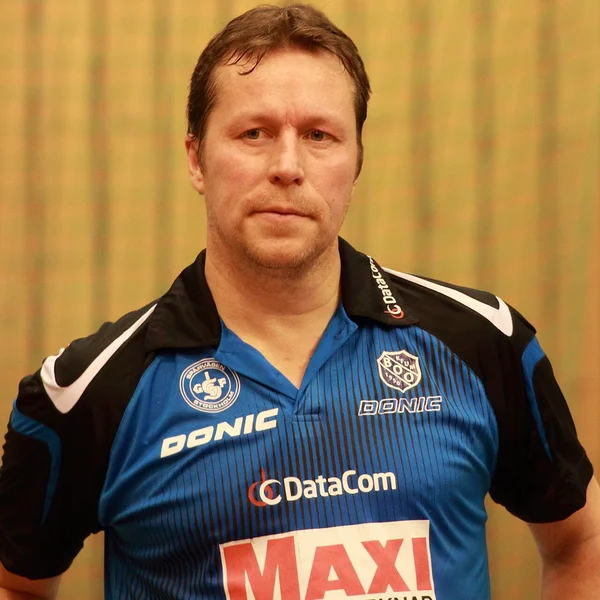
Jan-Ove Waldner is a Swedish table tennis (also known as ping pong) player who won the 1992 Olympic singles gold, 2 World Championship singles titles (1989, 1997), and the 1990 World Cup, playing a right-hand shakehand all-round attacking style across nearly five decades of elite competition. Waldner is the only non-Asian male player in history to complete the career Grand Slam, holding Olympic, World Championship, and World Cup singles titles simultaneously. His equipment centered on a custom Donic shakehand blade in the all-round-plus to off- speed range, paired with European tensor rubbers tuned for touch, deception, and service variation rather than raw exit speed. The sections below cover his career titles, the playing style that earned him the “Mozart of table tennis” nickname, the rivalries that defined men’s table tennis from the 1980s through the 2000s, and why Chinese fans renamed him “Lao Wa.”
What Equipment Did Jan-Ove Waldner Use?
Jan-Ove Waldner used a custom Donic shakehand blade for the bulk of his career, an all-wood construction in the all-round-plus to off- speed class with a flared handle. Donic sponsored Waldner from his 1980s peak through retirement and later released the Waldner Senso retail blade based on the same architectural family.
The table below summarizes the setup at the architectural level rather than specific SKUs, since rubber technology and ITTF glue rules changed dramatically across his career:
| Component | Specification | Notes |
|---|---|---|
| Blade | Custom Donic shakehand, all-wood, 5-ply | All-round-plus to off- speed class, flared handle, wood-only construction without carbon layers |
| Forehand rubber | European tensor or speed-glued sheet | Specific SKUs changed across the speed-glue and post-glue eras |
| Backhand rubber | European tensor sheet | Tuned for the deceptive backhand flick that defined his short-receive game |
| Sponsor era | Donic (long-term) | Donic Waldner Senso retail blade released as a commercial successor |
Waldner’s all-wood blade is the headline of his setup. Through the 1990s and 2000s most professionals migrated to arylate-carbon and ZLC composites for extra exit speed. Waldner stayed with wood because all-wood transmits more vibration on contact, giving finer information about the ball’s spin and depth, and for a player built on deception that feedback mattered more than the 12-18% exit-speed gain a carbon blade would have delivered. Shakehand players studying his setup often pick blades from the best table tennis paddles ranked by playing style guide that follow the same all-wood, control-first template.
Why Did Waldner Stay with Donic for His Entire Career?
Waldner stayed with Donic because the German manufacturer built blades to his exact specification rather than asking him to adapt to a retail product. The 30-year relationship was unusually long in a sport where most professionals switch brands several times. Donic was smaller than Butterfly or DHS through the 1980s and 1990s, and signing Waldner gave the brand its anchor athlete during the years when he won every major title. He received custom blades cut to his preferred weight and balance point; Donic gained the right to release commercial blades carrying his name, including the Waldner Senso line still in the catalogue. Compared to the Butterfly Viscaria Ma Long uses or the outer-ZLC Zhang Jike blade in Fan Zhendong’s setup, Waldner-era Donic blades sat at a lower speed class with no carbon reinforcement.
The rubber side shifted across the decades. The pre-2008 speed-glue era let players apply VOC glue that expanded the sponge and increased speed by 10-15%. After the ITTF banned VOC glues in 2008, Waldner adapted to factory-tuned tensor rubbers without dropping out of competitive play, a transition that ended several other careers from his generation.
How Did Waldner’s Tactical Style Earn Him “the Mozart” Nickname?
Waldner earned “the Mozart of table tennis” nickname because he constructed points the way a composer builds a phrase: with variation, anticipation, and a feel for when to break pattern. His signature was tactical creativity rather than physical dominance.
Three tactical patterns defined Waldner’s match play:
- Service variation. Waldner threw 5-7 different serves per match, mixing pendulum, reverse-pendulum, tomahawk, and short backspin with similar motions. Opponents could not read spin from his arm path alone.
- The deceptive backhand flick. From a short backspin serve, Waldner would step in and flick the ball with topspin off the bounce, placing the return into the opponent’s elbow or wide forehand. The motion looked like a pushed return until his wrist rotated at the last instant.
- Tempo control. Where modern players such as Fan Zhendong overwhelm with continuous fast topspin, Waldner alternated speeds within rallies. A heavy loop, a soft block, then a fast counter, breaking the opponent’s timing rhythm.
The Mozart label first appeared in European press during his late 1980s peak and captured the sense that Waldner was solving the match in real time rather than executing a pre-built game plan. The right shakehand all-round attacker playing style page covers the tactical framework, though his version operated at a level of improvisation no contemporary equalled.
What Are Jan-Ove Waldner’s Career Stats and Major Titles?
Waldner accumulated 1 Olympic singles gold (1992 Barcelona), 2 World Championship singles titles (1989, 1997), 1 World Cup singles title (1990), and multiple European Championship and World Team Championship golds across a career that ran from the late 1970s through 2016.
What Are Waldner’s Olympic Results?
Waldner competed at multiple Olympic Games starting from Seoul 1988, the first Games where table tennis was a medal sport:
- 1992 Barcelona: Won singles gold, defeating Jean-Philippe Gatien of France in the final. The win made Waldner the first European Olympic table tennis champion and completed his Grand Slam.
- 2000 Sydney: Won singles silver, losing to Kong Linghui of China in the final after a comeback run from injury that beat multiple top-ranked Chinese players. Many analysts rate this run more impressive than the 1992 gold given he was 35 and facing the dominant Chinese team.
- Later Games: Waldner continued to qualify and compete past age 40.
What Are Waldner’s World Championship Results?
Waldner won 2 World Championship singles titles with multiple silver and bronze medals across a 12-year window:
- 1989 Dortmund: Defeated Jiang Jialiang of China at age 23. Jiang had won the 1985 and 1987 Worlds and was the dominant Chinese player of the late 1980s.
- 1997 Manchester: Defeated Vladimir Samsonov of Belarus 21-19 in the deciding game. The match is one of the most-cited finals in the sport’s history because Waldner was 31 and considered past his prime.
- Silver: 1987 New Delhi, 1991 Chiba. Bronze: 1993 Gothenburg, 1999 Eindhoven.
What Are Waldner’s Other Major Titles?
Waldner won the 1990 World Cup in Chiba City, completing the career Grand Slam by 1992 when he added Olympic gold. He won multiple European Championship singles golds, including a triple gold at 1996 Bratislava (singles, doubles, team). He also led Sweden to 4 World Team Championship titles (1989, 1991, 1993, 2000) alongside Jorgen Persson, Mikael Appelgren, Erik Lindh, and Peter Karlsson, breaking a Chinese stranglehold on the team event that had run almost uninterrupted since the late 1960s.
Why Is Waldner the Only Non-Asian Male Grand Slam Champion?
Waldner is the only non-Asian male Grand Slam champion because the career Grand Slam requires winning Olympic, World Championship, and World Cup singles titles, and no other European or American male player has won all three. Jorgen Persson, Vladimir Samsonov, Timo Boll, and Werner Schlager each missed at least one.
The structural barrier is China’s dominance of the singles draw. Chinese men’s national team players have won the majority of major singles titles since 1959, and the gap widened after the 11-point scoring format took effect in 2001. Waldner’s Grand Slam was completed in 1992, before that scoring change and during a window when European players could match Chinese training infrastructure through creative tactics rather than drilling volume. No European has won a World Championship singles title since 1997.
The closest non-Asian Grand Slam contenders since Waldner are Timo Boll and Werner Schlager. Boll won multiple World Cup titles and reached world number 1 but never won Olympic or World Championship singles gold. Schlager won the 2003 Worlds at Paris but did not win the Olympic or World Cup singles.
How Did Waldner Compete at the Top Level for Five Decades?
Waldner competed at the top level for nearly 50 years because his game was built on tactical decisions and ball feel rather than peak physical output, and those skills decay slower than speed and reaction time. His training adjustments across the decades extended his competitive window past every contemporary’s.
In the 1980s, Waldner trained in China alongside the Chinese national team under a Sweden-China coaching exchange. His Mandarin fluency and willingness to live in Beijing earned him drills and coaching the rest of European table tennis did not see, accelerating his development by 3-5 years.
In the 1990s and 2000s, he cut weekly training volume but kept the same competitive schedule. Reduced volume preserved his joints; continued tournament play kept his match anticipation sharp. Younger opponents training twice the hours often peaked at 22-25 and declined by 30, while Waldner’s tactical library kept growing into his late 30s and 40s.
His final international singles run came at the 2008 Beijing Olympics at age 42, reaching the round of 16 before losing to Wang Liqin. He played Swedish league matches for several more years and retired in 2016 at age 50. Modern players studying his longevity blueprint combine selective tournament entry with reduced training volume, a pattern visible in Timo Boll’s late career and the post-Tokyo schedule of Ma Long.
When Did Jan-Ove Waldner Retire and What Has He Done Since?
Waldner retired from professional competition in 2016 at age 50, after a final season of selective Swedish league play and exhibition appearances. Since retirement he has stayed close to Swedish table tennis as an ambassador, exhibition player, and informal mentor to younger Swedish prospects.
The 2016 retirement was unusually quiet by professional sports standards. Waldner did not stage a farewell tour or take a coaching position with the Swedish national team. He plays recreational matches, attends major tournaments as a guest, and travels to China for exhibitions where he remains a household name. At the 2024 Paris Olympics, Swedish player Truls Moregard reached the singles final and credited Waldner as the reference point for the Swedish all-round attacking tradition; the Truls Moregard equipment and career profile documents that lineage. Donic continued to release Waldner-branded blades after his retirement, and players selecting from the best table tennis rubbers for every playing style often pair them with European tensor sheets to approximate his touch-first setup.
Why Is Waldner Called “Lao Wa” in China?
Waldner is called “Lao Wa” (老瓦, “Old Wa”) in China as an affectionate nickname combining respect for his age with the casual tone Chinese fans reserve for athletes they have followed across generations. A second nickname, “Chang Qing Shu” (常青树, “Evergreen Tree”), captures the same idea: a player who refused to fade.
His standing in China is unique among Western athletes in any sport. He trained in Beijing as a young player, spoke Mandarin well enough for live television interviews, and beat the strongest Chinese national team players at multiple Worlds and Olympics during the era when table tennis dominance was the country’s clearest sporting identity. Rather than treating him as a foreign rival, Chinese fans absorbed him as a respected outsider who beat the Chinese system on its own terms.
The “Lao Wa” name first appeared in Chinese press during his second wind at the 1997 Manchester Worlds and 2000 Sydney Olympics. “Wa” is the first character of his transliterated surname; “Lao” signals warmth and familiarity rather than condescension. His Grand Slam record and decades of competitive presence make Waldner a fixture in any Chinese discussion of the greatest table tennis players of all time, where he typically appears alongside Ma Long, Liu Guoliang, and Deng Yaping at the top of the all-time rankings rather than as a token Western entry.