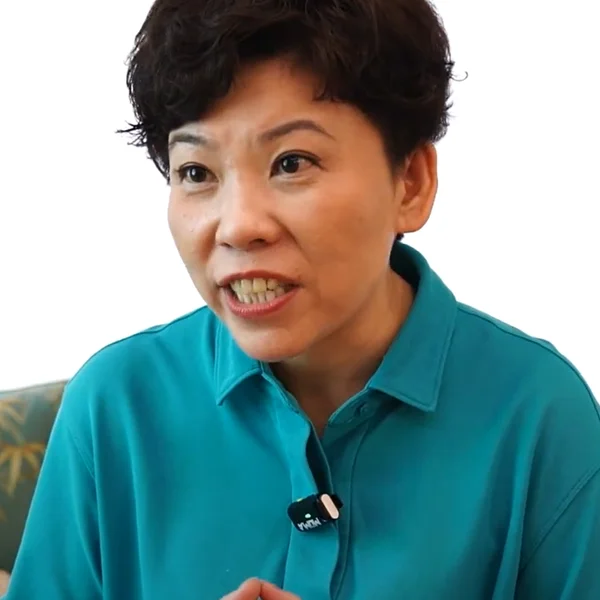
Deng Yaping is a retired Chinese table tennis player who holds 4 Olympic gold medals and 18 World Championship titles, playing a right-hand Chinese penhold grip with short pips on the backhand. Standing 1.50 m (4’11”), Deng Yaping built her game on relentless close-to-table attacking pressure, using the short-pips backhand to flatten incoming spin and the inverted forehand to drive winners through opposing defenses. She held the world number 1 ranking for 8 consecutive years between 1990 and 1997, the longest unbroken run in women’s table tennis at that point. The sections below cover Deng Yaping’s equipment configuration in the context of 1990s Chinese national-team play, explain how her playing style compensated for the height disadvantage that scouts initially flagged as disqualifying, document her career stats across 4 Olympic Games and 5 World Championship cycles, and trace her post-retirement education at Nottingham and Cambridge.
What Equipment Did Deng Yaping Use?
Deng Yaping used a Chinese-style penhold blade fitted with short pips rubber on the backhand and inverted rubber on the forehand, the standard configuration for Chinese national-team penhold attackers throughout the 1990s. Specific blade and rubber model names were not publicly catalogued during her competitive career.
Equipment documentation in the 1990s differed sharply from the present era. Chinese national-team players often used custom blades produced in limited runs by the Beijing equipment workshop, and contracted rubber sheets from DHS or Friendship that did not always carry retail-equivalent model designations. What can be verified from match footage and contemporary coaching texts is the architectural configuration:
| Component | Specification | Function in Deng Yaping’s Game |
|---|---|---|
| Blade | Chinese penhold (single-sided handle, no flared grip) | Short, vertical handle suited the thumb-and-forefinger pinch grip required for penhold play |
| Forehand rubber | Inverted (smooth) topsheet, Chinese tacky | Generated topspin on forehand drives and counter-loops |
| Backhand rubber | Short pips, thin sponge | Flattened incoming topspin, returned the ball with reduced spin and a flatter trajectory |
| Grip | Right-hand Chinese penhold, no reverse-penhold backhand | Forehand-dominant attack pattern with backhand block-and-punch coverage |
The short-pips backhand defined the tactical character of Deng Yaping’s play. Where shakehand players counter heavy topspin with their own loops, short-pips rubber returns the ball with the spin partially neutralized and the trajectory flatter. For a 1.50 m player facing taller opponents who could loop down at her from above the net, the short-pips backhand removed the height advantage opponents tried to exploit.
Why Did Deng Yaping Use a Penhold Grip with Short Pips?
Deng Yaping used the Chinese penhold grip because it was the dominant Chinese national-team style for women in the 1980s and 1990s, and she paired it with short pips on the backhand because the combination neutralized the topspin attacks of taller European and Korean shakehand players.
The Chinese penhold grip in this era did not include the reverse-penhold backhand stroke that later players such as Wang Hao and Xu Xin developed. The backhand side of a 1990s Chinese penhold paddle covered a narrower range of strokes: blocks, punches, and pushes, with limited topspin generation from the backhand wing. Short pips rubber compensated by treating the backhand as a counter-attacking tool rather than a spin-generating one.
The pips structure produces three distinct effects on incoming ball spin:
- Spin reversal on heavy topspin: Incoming topspin contacts the pip tips before reaching the sponge, deflecting upward off the rubber surface with the rotation partially reversed. The ball returns with backspin or near-zero spin, disrupting the rhythm of opponents who expect topspin returns.
- Flatter trajectory: Short pips have less surface friction than inverted rubber. The ball leaves the paddle with a lower throw angle, traveling on a flat, fast path that crosses the net early in the stroke arc.
- Reduced sensitivity to incoming spin: The pips structure absorbs less rotational energy from the incoming ball. Deng Yaping could block heavy topspin loops without adjusting paddle angle as precisely as a shakehand defender using inverted rubber would need to.
For a player who stood at 1.50 m, the short-pips backhand turned a structural weakness (short reach, low contact point) into a tactical weapon. Opponents looping down at her backhand received their own spin back, flatter and faster than they had sent it.
How Did Deng Yaping’s Playing Style Compensate for Her Height?
Deng Yaping’s style compensated for her 1.50 m height through three coordinated tactics: standing close to the table to take the ball early, using short pips on the backhand to neutralize topspin from above, and attacking with the forehand from a wider stance that maximized her stroke arc.
Chinese national-team scouts initially dismissed Deng Yaping for being too short. Standard scouting practice favored players who could reach further across the table and contact the ball at a higher point above the net. Deng Yaping’s eventual selection came after she demonstrated that close-to-table positioning eliminated the disadvantage by removing the time and distance opponents needed to exploit her reach.
Three positioning principles defined her court coverage. She kept her ready position within 30 cm of the table edge, taking incoming balls on the rise rather than letting them drop into her hitting zone. She compressed her backswing to match the short reaction window, using a wrist-driven backhand block that did not require a full forearm rotation. She moved laterally with short, quick steps rather than the longer cross-steps that taller players use to cover the wide forehand corner.
The forehand attack carried the bulk of her offense. From the close-to-table position, she drove forehand winners through opponents’ middle and wide forehand corner, using the close-to-table aggressive looping playing style decades before the term entered common coaching vocabulary. Her stroke arc on the forehand stayed compact, with most of the power generated by hip rotation and forearm snap rather than a long backswing.
Opponents who tried to exploit her height with high loops to the backhand met the short-pips block, which returned the ball flatter and faster than they expected. Opponents who pushed wide to her forehand met an attacking drive from a balanced stance. The combination produced one of the most consistent attacking patterns of the 1990s women’s circuit.
What Are Deng Yaping’s Career Stats and Major Titles?
Deng Yaping won 4 Olympic gold medals (2 singles in 1992 and 1996, 2 doubles in 1992 and 1996), 18 World Championship titles across singles, doubles, mixed doubles, and team events, and held the world number 1 ranking for 8 consecutive years between 1990 and 1997.
Her competitive career ran 9 years, from her 1988 selection to the Chinese national team through her 1997 retirement at age 24. Within that span she contested 2 Olympic Games and 5 World Championship cycles, missing none of the major events for which she was eligible.
The headline numbers break down as follows:
- Olympic singles golds: 2 (1992 Barcelona, 1996 Atlanta)
- Olympic doubles golds: 2 (1992 Barcelona with Qiao Hong, 1996 Atlanta with Qiao Hong)
- World Championship singles titles: 3 (1991, 1995, 1997)
- World Championship doubles, mixed doubles, and team titles: 15 (combined)
- World number 1 weeks: 8 consecutive years, 1990 through 1997
- Career length at retirement: Age 24, 9 years of senior competition
The 18 World Championship titles spread across all four event categories. Her 3 singles titles came at Chiba 1991, Tianjin 1995, and Manchester 1997. Doubles partnerships with Qiao Hong produced multiple women’s doubles golds. Mixed doubles partnerships and team events contributed the remaining titles. At her retirement, no other player in the sport (men or women) had accumulated more World Championship titles within a single career.
How Many Olympic Gold Medals Did Deng Yaping Win?
Deng Yaping won 4 Olympic gold medals, taking both the singles and doubles titles at the 1992 Barcelona Games and repeating the same double at the 1996 Atlanta Games. No other women’s table tennis player has won 2 Olympic singles gold medals in consecutive Games while also winning the corresponding doubles gold in both editions.
The 1992 Barcelona Games marked the second Olympics to include table tennis (after Seoul 1988). Deng Yaping won the singles gold at age 19, defeating Qiao Hong in the final, and partnered with Qiao Hong to win the doubles gold the same week. The 1996 Atlanta Games followed an identical pattern: singles gold over Chen Jing in the final, doubles gold with Qiao Hong.
Across both Olympic cycles, Deng Yaping went undefeated in singles play. The combined 4-medal haul placed her in a category occupied by no other women’s table tennis player at the time and remains a benchmark that later stars such as Sun Yingsha and Ding Ning have approached without matching exactly.
Why Is Deng Yaping Considered One of the Greatest Players Ever?
Deng Yaping is considered one of the greatest table tennis players ever because of her 8 consecutive years at world number 1, her 4 Olympic gold medals, and her 18 World Championship titles, accumulated within a 9-year career that ended at age 24. The titles-per-year ratio remains unmatched in the sport.
Three statistical comparisons frame the case. First, her career singles win rate against top-10 opponents through the 1990-1997 period exceeded the win rates of contemporary champions in the men’s draw. Second, her 8-year run at world number 1 outlasted every comparable streak in women’s table tennis up to her retirement. Third, her retirement age of 24 truncated what could have been a longer haul, leaving the question of how high her totals would have climbed had she continued through the 2000 Sydney Olympics.
Beyond pure statistics, Deng Yaping’s place in the sport’s history rests on her role in proving that the Chinese penhold style with short pips remained competitive against the rising shakehand orthodoxy of the 1990s. By the late 1990s, most international women’s players had moved to shakehand grips with inverted rubber on both sides. Deng Yaping’s continued dominance with the older configuration delayed the full transition for several years and influenced how Chinese coaches approached penhold development through the 2000s.
The greatest table tennis players of all time ranking covers Deng Yaping’s full statistical record alongside Jan-Ove Waldner, Ma Long, and other career-haul leaders across both men’s and women’s competition.
When Did Deng Yaping Retire and What Has She Done Since?
Deng Yaping retired in 1997 at age 24, immediately after the Manchester World Championships, where she won her third singles title. Her post-retirement path moved through three phases: a Bachelor’s degree at Tsinghua University, a Master’s research degree at the University of Nottingham, and a PhD in Land Economy at the University of Cambridge (completed 2008).
The Cambridge PhD thesis, “Olympic branding and global competition: the case of Beijing 2008,” tied directly to her concurrent role as a senior administrator for the 2008 Beijing Olympics, where she served as deputy mayor of the Olympic Village. The combination of doctoral research and operational responsibility for one of the largest Olympic Games in modern history was unusual for a recently retired athlete.
Subsequent roles included CEO of Jike Search (a state-run search engine that operated 2011-2013), International Olympic Committee Athletes’ Commission membership, and Laureus World Sports Academy membership. She was inducted into the International Table Tennis Federation Hall of Fame in 2003 and voted Chinese female athlete of the century by domestic sports media.
The educational arc set Deng Yaping apart from the typical retirement pattern of Chinese national-team athletes, who more commonly transition into coaching or sports administration without pursuing doctoral-level academic work in unrelated fields.
How Does Deng Yaping’s Era Compare to Modern Women’s Table Tennis?
Deng Yaping’s era differed from modern women’s table tennis in three measurable ways: ball size (38 mm versus today’s 40+ plastic ball), scoring format (21-point sets versus today’s 11-point sets), and dominant playing style (penhold with short pips versus today’s shakehand with inverted rubber on both sides).
The 38 mm celluloid ball in use during Deng Yaping’s career rotated faster and traveled at higher exit speeds than the 40+ plastic ball introduced in 2014. Heavier spin on the smaller ball rewarded players who could generate topspin at high RPMs, while the lower bounce off the table favored close-to-table aggression. The transition to the larger plastic ball reduced spin generation by approximately 10-15%, lowered ball speed, and extended rallies by giving defensive players more time to react.
The 21-point scoring format, in use through 2001, spread points across longer sets and rewarded consistency over short bursts of brilliance. Players could absorb several lost points in a row and recover within the same set. The 11-point format adopted afterward compresses the margin for error, punishing momentary lapses more harshly than the 21-point system did. Deng Yaping’s career stats are scored under the 21-point format, while Sun Yingsha’s career and other modern records sit under the 11-point format, complicating direct title-count comparisons.
The shift away from penhold play represents the largest stylistic break between her era and today. In the 1990s, roughly 40% of top-50 women’s players used some form of penhold grip. By the 2020s, that figure had dropped below 5%, with shakehand becoming nearly universal. The reverse-penhold backhand technique that emerged in the 2000s gave penhold players a topspin backhand option, but most coaches concluded that shakehand offered easier two-wing development for new players.
Equipment commercialization also separates the eras. The best table tennis paddles ranked by playing style and best table tennis rubbers for every playing style guides cover modern setups in detail, drawing on standardized model lines that simply did not exist for national-team players during the 1990s. Deng Yaping’s equipment was custom or quasi-custom, while Fan Zhendong and other current players use commercially available blades and rubbers (often with national-team-spec sponge variants) that any informed buyer can replicate.
What carries forward from Deng Yaping’s era is the close-to-table attacking template. Her style of standing within 30 cm of the table edge, taking the ball on the rise, and pressuring opponents with continuous attacks remains the dominant approach in modern Chinese women’s play, even though the grip and rubber configurations have changed. The tactical philosophy outlived the equipment that originally implemented it.