Killerspin Table Tennis: Brand Guide, Best Products, and History
Founded 2001
Killerspin makes design-forward JET paddles ($30-130) and MyT tables ($500-3000+) from Chicago since 2001. Compare every JET model by skill level.
· UpdatedKillerspin is a Chicago-based table tennis brand founded in 2001 by Robert Blackwell Jr. that sells design-forward paddles, tables, and accessories to the recreational and home market. The company’s JET paddle series spans 5 models from $30 (JET200) to $130 (JET800), and its table lineup runs from the MyT4 folding table at $500 to the Revolution SVR transparent-panel showpiece at $3,000+. Killerspin holds a unique position in table tennis equipment: the brand competes on visual design, packaging presentation, and lifestyle branding rather than on professional endorsements or tournament adoption rates.
Killerspin’s website comparison tool ranks #1 in Google search results for “best table tennis paddles,” giving the brand outsized visibility among buyers researching paddle purchases. That ranking reflects Killerspin’s investment in web content and product comparison infrastructure, not professional player endorsement. No players on the ITTF World Tour or in major national team programs use Killerspin equipment in competition. The brand’s strength sits in the $30-130 paddle range and the $500-3,000 table range, where build quality and presentation matter more to buyers than spin RPM ratings or sponge hardness specifications.
What Makes Killerspin Different from Traditional Table Tennis Brands?
Killerspin entered the table tennis market in 2001 with a business model built around design aesthetics and consumer packaging rather than competitive performance research. Robert Blackwell Jr. founded the company in Chicago, Illinois, targeting a buyer segment that Butterfly, DHS, and STIGA largely ignored: people who wanted table tennis equipment that looked premium on a shelf, arrived in gift-ready packaging, and matched the visual standards of home and office decor.
Traditional table tennis brands invest in sponge chemistry, blade composition testing, and professional player sponsorships. Butterfly spends R&D budget on Spring Sponge micro-cellular structures. DHS develops tacky rubber compounds for the Chinese National Team. Killerspin invests in industrial design, unboxing presentation, and retail display. The JET paddle boxes open with magnetic closures and foam inserts, a detail irrelevant to on-table performance but central to the gift and retail experience.
The company also hosts Killerspin events in U.S. cities, combining table tennis with entertainment, music, and social media content. These events serve a marketing function rather than a competitive development function. No Killerspin-sponsored event carries USATT or ITTF sanctioning. The events bring table tennis visibility to audiences who would not attend a traditional tournament, expanding the recreational player base without intersecting the competitive pipeline.
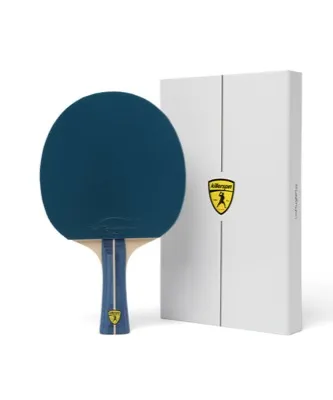
Holding a JET paddle next to a Butterfly Timo Boll ALC setup reveals the design difference immediately. The JET paddles use bold color accents on the handle and edge tape, with a rubberized grip texture that feels closer to consumer electronics than to traditional cork or flared wood handles. The blade profiles run slightly thicker than competition-spec paddles at equivalent ply counts.
Which Killerspin JET Paddles Match Each Skill Level?
Killerspin JET paddles cover 5 tiers from beginner control at $30 to advanced recreational performance at $130. Every JET paddle ships fully assembled with factory-bonded rubber that is not replaceable, following the same premade format as the Butterfly 401 and STIGA Pro Carbon.
Killerspin JET200: Entry-Level Control Paddle
The Killerspin JET200 uses a 5-ply wood blade with basic inverted rubber on both sides at a price of $30. Speed rates 5.0/10 and spin rates 4.5/10 on the Killerspin scale. The JET200 weighs approximately 165 g assembled, sitting at the light end of the premade paddle spectrum.
Ball contact on the JET200 returns a muted, damped sound with minimal rebound, consistent with the low-speed rubber and soft sponge pairing. New players learning push and block strokes benefit from the low pace, which keeps rallies on the table during the first weeks of play. The Killerspin JET200 review breaks down the paddle’s specs against other beginner premades.
Killerspin JET400: Intermediate Spin and Speed
The Killerspin JET400 steps up to a 5-ply blade with upgraded rubber at $50. Speed rates 7.0/10 and spin rates 7.0/10 on the Killerspin scale. The rubber topsheet grips the ball visibly more on brushing strokes compared to the JET200, allowing developing players to start generating topspin on serves and forehand loops.
The JET400 is the inflection point in the JET lineup where stroke technique begins to affect shot quality. A flat hit and a brushing loop produce noticeably different trajectories with the JET400 rubber, while the JET200’s lower-grip surface makes those two strokes feel almost identical. The Killerspin JET400 review covers the performance gap between the JET200 and JET400 in detail.
Killerspin JET600: Advanced Recreational Play
The Killerspin JET600 uses a 5-ply blade with Jet Basic rubbers at $80. Speed rates 8.0/10 and spin rates 8.5/10 on the Killerspin scale, placing the JET600 in the same performance tier as the STIGA Pro Carbon ($65) and Butterfly Marcos Freitas MFX1 ($55).
At this price point, Killerspin charges a premium for design and packaging over raw performance. The STIGA Pro Carbon packs carbon fiber into its blade construction for the same $65, while the JET600 stays with 5-ply wood at $80. The JET600’s advantage is cosmetic fit and finish: the handle ergonomics, edge tape quality, and visual presentation exceed most paddles in the $60-100 range.
Killerspin JET800: Top-of-Line Premade Performance
The Killerspin JET800 represents the ceiling of Killerspin’s paddle lineup at $130 with a 7-ply wood blade and Nitrx-4Z rubber rated 9.0 speed and 9.0 spin on the Killerspin scale. The additional 2 plies over the JET600’s 5-ply blade add stiffness and power transfer on full swings.
Tapping the JET800 blade with a knuckle returns a higher-pitched, stiffer tone compared to the JET600’s more flexible response. The Nitrx-4Z rubber is the most responsive surface in the Killerspin lineup, with enough grip to execute consistent topspin loops from mid-distance. At $130, the JET800 costs more than a custom beginner setup (Butterfly Primorac blade + Rozena rubber, $150-190 total) that offers replaceable rubber and longer total lifespan.
| JET Model | Plies | Speed Rating | Spin Rating | Price | Target Player |
|---|---|---|---|---|---|
| JET200 | 5-ply | 5.0/10 | 4.5/10 | $30 | Beginner, first paddle |
| JET400 | 5-ply | 7.0/10 | 7.0/10 | $50 | Developing recreational |
| JET600 | 5-ply | 8.0/10 | 8.5/10 | $80 | Advanced recreational |
| JET800 | 7-ply | 9.0/10 | 9.0/10 | $130 | Top recreational |
Speed and spin ratings use Killerspin’s internal scale, which does not map directly to Butterfly’s or STIGA’s rating systems. A JET800 rated 9.0 speed on the Killerspin scale does not equal a Butterfly rubber rated 13.0 on Butterfly’s scale. Cross-brand comparison requires testing under identical stroke conditions. The best table tennis paddles ranked by playing style standardizes performance comparisons across brands.
Which Killerspin Tables Fit Home and Office Spaces?
Killerspin tables range from $500 for the MyT4 to $3,000+ for the Revolution SVR, targeting buyers who treat the table as furniture and decor, not just sports equipment. All Killerspin tables meet regulation ITTF dimensions (9 ft x 5 ft x 2.5 ft) and fold for storage.
Killerspin MyT Series: Folding Tables for Home Play
The MyT series includes 4 primary models scaled by tabletop thickness and frame quality:
- MyT4 ($500-700): 15 mm tabletop, steel frame, basic net. Entry point for home play. The 15 mm surface produces a lower, less consistent bounce compared to competition-spec 25 mm tables.
- MyT5 ($700-900): 18 mm tabletop, reinforced steel legs, upgraded net. The 3 mm thickness increase over the MyT4 raises bounce consistency measurably on drop tests from 30 cm height.
- MyT7 ($1,000-1,500): 22 mm tabletop, anti-tilting legs, professional-grade net. Enters the club-quality thickness range where ball bounce approaches regulation standards.
- MyT10 ($2,000+): 25 mm tabletop, competition-grade construction, premium casters. Matches ITTF bounce specifications at the same 25 mm thickness used in tournament tables from Butterfly and JOOLA.
All MyT tables fold in half with a self-locking mechanism and roll on 4 casters. The folded footprint measures approximately 60 x 60 x 160 cm (varies by model), narrow enough to store against a garage or basement wall.
Killerspin Revolution SVR: Transparent Design Statement Table
The Killerspin Revolution SVR replaces the standard wood tabletop with transparent acrylic panels at a price above $3,000. The SVR is a design object first and a playing surface second. The acrylic surface alters ball bounce characteristics compared to standard MDF or particleboard tops: the ball skids lower and faster, with less friction on the surface. Competitive players accustomed to standard table bounce find the SVR surface unpredictable for spin-heavy rallies.
The SVR appears in corporate offices, luxury game rooms, and entertainment venues where visual impact drives the purchase decision. As a practice or training surface for competitive players, the SVR’s non-standard bounce makes stroke development inconsistent. As a conversation piece and recreational table, the SVR fills a category where no other table tennis brand competes.
The best table tennis tables for home and club play ranks tables by playing surface quality, bounce consistency, and price across Killerspin, JOOLA, Butterfly, and STIGA.
How Does Killerspin Compare to Butterfly, JOOLA, and STIGA?
Killerspin paddles cost 30-60% more than equivalent STIGA and JOOLA premades at the same performance tier. Killerspin tables price competitively against JOOLA in the $500-1,500 range and carry a premium above $2,000 for design-forward models like the Revolution SVR.
| Category | Killerspin | Butterfly | JOOLA | STIGA |
|---|---|---|---|---|
| Beginner paddle | JET200 $30 | 401 $30 | Team School $20 | Apex $25 |
| Mid-range paddle | JET600 $80 | MFX1 $55 | Infinity $50 | Pro Carbon $65 |
| Top premade paddle | JET800 $130 | N/A (custom setups) | N/A | N/A |
| Entry table | MyT4 $500-700 | N/A | Inside 15 $350-500 | Advantage $300-400 |
| Mid table | MyT7 $1,000-1,500 | N/A | Rally TL $700-900 | Premium $600-800 |
| Premium table | Revolution SVR $3,000+ | N/A | Infinity $1,500-2,000 | N/A |
| Professional endorsements | None | Timo Boll, Harimoto | Multiple ITTF players | Multiple ITTF players |
| Tournament adoption | None | 46.9% World Championship rubber usage | Official Olympic table supplier | Widespread club use |
The comparison clarifies Killerspin’s market position. Butterfly, JOOLA, and STIGA all maintain active professional player rosters and appear at ITTF-sanctioned events. Killerspin has zero presence in sanctioned competitive table tennis. The brand competes in the consumer retail channel, where packaging, visual design, and brand perception drive purchase decisions among buyers who play 1-4 hours per week at home or in office break rooms.
Price-per-performance favors JOOLA and STIGA at every paddle tier. The JOOLA Inside 15 table ($350-500) undercuts the Killerspin MyT4 ($500-700) with similar 15 mm playing surfaces. The STIGA Pro Carbon paddle ($65) matches or exceeds JET600 ($80) performance through its carbon blade construction. Killerspin’s price premium reflects design, packaging, and brand positioning, not measurable on-table performance advantages.
How Does the Killerspin Comparison Tool Rank Paddles?
Killerspin.com hosts a paddle comparison tool that currently ranks #1 in Google results for “best table tennis paddles,” one of the highest-volume queries in the table tennis equipment category. The tool lets users filter paddles by skill level, playing style, and price, then displays Killerspin products alongside brief specs.
The comparison tool’s Google ranking reflects strong on-page SEO and structured data implementation, not an industry consensus that Killerspin makes the best paddles. The tool exclusively recommends Killerspin products. Buyers using the tool for research see only JET-series paddles and Killerspin-branded accessories, with no cross-brand comparison against Butterfly, DHS, STIGA, or JOOLA.
For recreational buyers choosing their first or second paddle, the Killerspin comparison tool narrows options within the JET lineup effectively. For competitive players or anyone comparing across brands, the tool’s single-brand scope limits its usefulness. A full cross-brand paddle comparison covering 15+ paddles across all skill levels and price points is available in the best table tennis paddles guide.
Who Benefits Most from Killerspin Equipment?
Killerspin equipment fits 3 buyer profiles where design, presentation, and recreational use outweigh competitive performance requirements.
Home recreation players (1-3 hours per week, no tournament ambitions): The JET200 ($30) or JET400 ($50) paired with a MyT4 or MyT5 table provides a complete home setup between $530 and $950. The equipment handles casual rallies, family play, and beginner skill development without requiring rubber replacement, blade selection, or gluing knowledge.
Office and corporate buyers: Killerspin tables appear in tech company break rooms, co-working spaces, and corporate rec areas where the table functions as furniture. The MyT7 and MyT10 models match the visual standards expected in professional office environments. The Revolution SVR serves as a design centerpiece in lobbies and entertainment spaces where standard green or blue competition tables look out of place.
Gift buyers: The JET paddle packaging (magnetic closure boxes, foam inserts, premium printing) is built for gift giving. A JET600 or JET800 in its retail packaging presents better as a gift than a Butterfly Timo Boll ALC blade shipped in a plain cardboard box, even though the Butterfly blade outperforms the Killerspin paddle on every measurable spec.
Players who train 4+ hours per week, compete in USATT or ITTF-sanctioned events, or plan to upgrade rubber separately from the blade outgrow Killerspin’s product range. The JET paddles use factory-bonded rubber that cannot be replaced, capping the equipment’s lifespan at 6-12 months of regular play. A custom setup from Butterfly, STIGA, or JOOLA at the same total cost as a JET800 ($130) allows rubber replacement every 2-4 months, extending the blade’s useful life to 3-5 years.
Killerspin Paddles
Killerspin Tables
Killerspin MyT5
$500–650
Killerspin Accessories
Killerspin Sets
Killerspin Products Featured In Our Guides
- Best Table Tennis Paddles for Advanced and Professional Players
- Complete Beginner Table Tennis Setup Guide: Paddle, Table, Balls, and Accessories
- Best Table Tennis Paddles: Complete Buyer's Guide
- 5 Best Premade Table Tennis Paddles in 2026
- Best Table Tennis Paddles for Beginners
- Best Table Tennis Paddles for Intermediate Players
- Best Table Tennis Tables for Home and Club Play
- Best Table Tennis Accessories and Training Aids in 2026
- 5 Best Table Tennis Paddles Under $50 in 2026
- Complete Guide to Table Tennis Equipment: Paddles, Rubbers, Tables, and Gear
- 5 Best Table Tennis Sets for Recreation and Family Play in 2026
Is Killerspin a good table tennis brand?
Killerspin is the top-selling design-oriented table tennis brand in the United States. The company's JET paddles and MyT tables target recreational and home players who prioritize build quality, packaging, and visual design over competitive performance specs. Killerspin equipment is not used on the professional tournament circuit.
Where is Killerspin table tennis made?
Killerspin was founded in 2001 in Chicago, Illinois by Robert Blackwell Jr. The company designs products in Chicago and manufactures through overseas production facilities. Killerspin distributes through its own website, Amazon, and U.S. sporting goods retailers.
What is the difference between Killerspin JET200 and JET800?
The Killerspin JET200 ($30) uses a 5-ply wood blade with basic rubber for beginner control. The Killerspin JET800 ($130) uses a 7-ply wood blade with Nitrx-4Z rubber rated 9.0 speed and 9.0 spin on the Killerspin scale. The JET800 weighs 15-20 g more than the JET200 and hits with noticeably more pace on full swings.